

Your sleep tracker says you slept badly.
Maybe your deep sleep was too low. Your sleep score dropped. You woke up more often than usual. Or the app gave you a red warning when you expected to see green.
Then something strange happens: you start feeling worse about your sleep than you did before you checked the data.
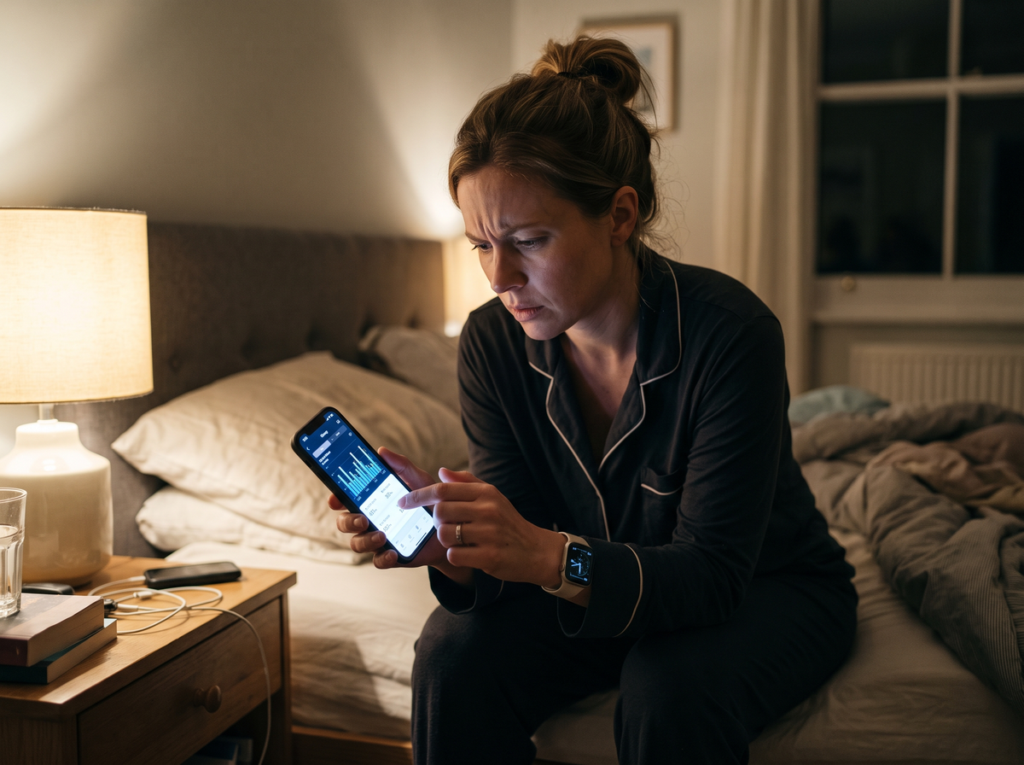
You replay the numbers. You wonder what went wrong. You start planning how to get a better score tonight.
And when bedtime arrives, instead of simply getting sleepy, you feel like you have another test to pass.
This growing problem has a name: orthosomnia.
Orthosomnia describes an unhealthy preoccupation with achieving ideal or “perfect” sleep—often driven or intensified by data from wearable sleep trackers and apps.
Sleep tracking itself isn’t necessarily the problem. A tracker can help you recognize patterns, build healthier routines, and become more aware of your sleep.
The trouble begins when the data stops informing you and starts controlling you.
Key Takeaways
- Orthosomnia describes excessive concern with achieving perfect sleep, particularly when that concern revolves around sleep-tracker data.
- It is an emerging sleep concept, not currently a standalone medical diagnosis with universally accepted diagnostic criteria.
- Sleep trackers estimate sleep from signals such as movement and heart rate; their numbers should not automatically be treated as precise measurements of what happened inside your brain overnight.
- Constantly checking scores, worrying about sleep stages, and changing your behavior to “fix” individual nights can increase sleep-related anxiety.
- The goal doesn’t have to be abandoning sleep technology. For many people, the healthier approach is to put the data back in perspective.
- If tracking consistently makes you more anxious, more preoccupied with sleep, or less able to trust your own experience, taking a break may be helpful.
Table of Contents
What Is Orthosomnia?
The term “orthosomnia” was introduced in 2017 by the sleep researchers who first described orthosomnia to characterize patients who became preoccupied with improving or perfecting the sleep data generated by wearable devices.
The word combines ortho, meaning correct or proper, with somnia, meaning sleep.
The researchers noticed something paradoxical in their clinical practice.
Patients were using technology designed to help them understand their sleep, but some became so focused on achieving ideal numbers that their efforts appeared to interfere with the very thing they were trying to improve.
Some trusted the tracker more than their own experience. Others spent excessive time in bed trying to increase the number of hours recorded as sleep. Tracker results could reinforce worries about sleep quality even when clinical testing told a different story.
Orthosomnia was born as a way of describing that pattern.
Importantly, orthosomnia isn’t currently an official standalone sleep disorder diagnosis. Research into how it should be defined and measured is still developing.
That distinction matters.
Seeing one disappointing sleep score—or simply enjoying sleep tracking—doesn’t mean you have orthosomnia.
The more useful question is:
What is the tracking doing to your relationship with sleep?
The Sleep Tracker Paradox
Sleep trackers give us something humans have never had easy access to before: a nightly report card for sleep.
You may wake up and immediately see:
- total sleep time
- sleep efficiency
- nighttime awakenings
- resting heart rate
- heart rate variability
- estimated REM sleep
- estimated deep sleep
- readiness or recovery scores
- an overall sleep score
That information can be fascinating and useful.
But it can also change the way you think about sleep.
Before wearables, you might have woken up and thought:
“I actually feel pretty good today.”
Now you might wake up feeling fine, look at a score of 62, and think:
“Apparently I slept terribly.”
The number can begin overriding your lived experience.
And once that happens, sleep tracking can quietly turn into sleep judging.
Your sleep tracker should be a tool for understanding your sleep—not a nightly test you have to pass.
Why Your Sleep Tracker Isn’t the Final Authority on Your Sleep
Consumer sleep trackers can provide useful estimates, but they don’t measure sleep the same way a clinical sleep study does.
Polysomnography—the standard laboratory method for evaluating sleep—uses measurements such as brain waves, eye movements, muscle activity, breathing, oxygen levels, and heart activity.
Most consumer wearables infer sleep using a much smaller set of signals, commonly including movement and cardiovascular data.
That distinction is especially important when looking at individual sleep stages.
The American Academy of Sleep Medicine has cautioned that consumer sleep technology should not replace medical evaluation when it comes to diagnosing or treating sleep disorders.
Technology continues to improve, and some modern devices can identify broad patterns reasonably well. But accuracy can vary among consumer sleep devices, as well as between algorithms, individuals, and the specific sleep metrics being measured.
So if your wearable says you got 47 minutes of deep sleep, that number is better interpreted as an estimate produced by an algorithm, not an indisputable measurement of exactly how many minutes your brain spent in deep sleep.
That doesn’t make the data worthless.
It simply means the data deserves context.
How Sleep Tracking Can Turn Into Sleep Anxiety
The problem usually isn’t one number.
It’s the feedback loop that can develop around it.
1. You track your sleep.
You wake up and check your results.
2. You see something you don’t like.
Your score is low, deep sleep declined, or the tracker detected several awakenings.
3. You become concerned.
“Why was my deep sleep so bad?”
“What did I do wrong?”
“Am I going to be exhausted today?”
4. You try harder to sleep perfectly.
You extend your time in bed, add new supplements or routines, cancel evening plans, move bedtime earlier, or become increasingly rigid about your sleep environment.
5. Bedtime becomes a performance.
Instead of allowing sleep to happen, you monitor whether it is happening.
6. Increased effort creates increased arousal.
Now you’re lying in bed thinking about sleep rather than sleeping.
7. Tomorrow morning, you check the tracker again.
And the cycle begins again.
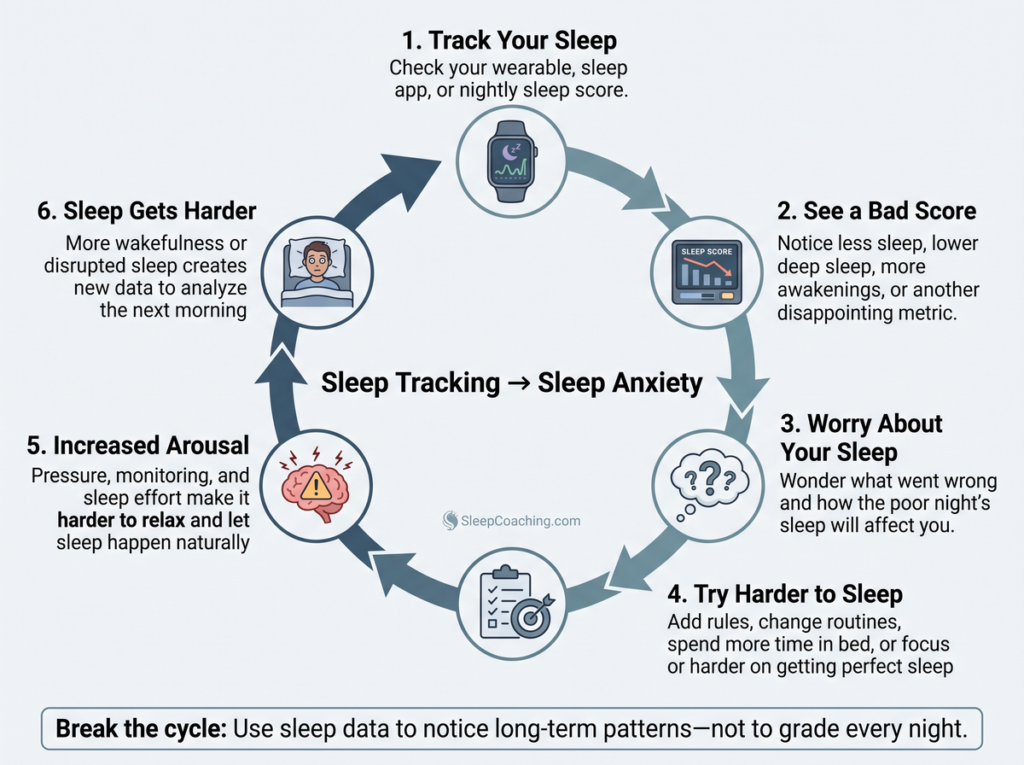
This is where orthosomnia overlaps with one of the great contradictions of insomnia:
Sleep is important, but trying too hard to force it can make it harder to achieve.
When Sleepmaxxing Becomes Sleep Perfectionism
The rise of orthosomnia also fits into the broader trend of sleepmaxxing—trying to optimize sleep through routines, products, supplements, wearables, and other interventions.
There is nothing inherently wrong with wanting better sleep.
In fact, taking sleep seriously is generally a positive change in a culture that has often treated sleep deprivation like a badge of honor.
But optimization has a natural trap:
If better sleep is good, perfect sleep can start to feel even better.
Suddenly seven hours and 42 minutes doesn’t feel sufficient because your goal was eight.
A sleep score of 84 feels disappointing because last week you reached 91.
One night with less deep sleep becomes a problem that needs solving.
You keep adding rules:
No caffeine after 10 a.m.
No dinner after 6:30.
No screens after 8.
Bed at precisely 10:17.
Exactly 68 degrees.
Magnesium.
Eye mask.
Mouth tape.
White noise.
Red light.
Breathing exercises.
Sleep tracker fully charged.
None of these things necessarily causes a problem on its own.
The problem is what happens when your sleep routine becomes so elaborate and rigid that breaking the routine feels dangerous.
Healthy sleep habits should support your life.
Your life shouldn’t have to revolve around protecting a perfect night of sleep.
Signs Your Sleep Tracking May Be Becoming Unhelpful
Orthosomnia isn’t defined by how frequently you wear a device. It is more about your relationship with the information it provides.
You may want to reconsider your tracking habits if you notice that:
- you check your sleep score immediately after waking and it strongly affects your mood
- you feel anxious when your sleep metrics decline
- you trust your tracker more than how rested or alert you actually feel
- you repeatedly analyze individual nights looking for what went wrong
- you obsess over getting enough REM or deep sleep
- you spend excessive time in bed trying to increase your recorded sleep duration
- you frequently change routines, foods, supplements, or behaviors based on small fluctuations in your data
- you become afraid that a less-than-perfect night will ruin the following day
- you avoid travel, social events, or other enjoyable activities because they might hurt your sleep score
- you feel compelled to keep tracking even though tracking makes you anxious
- you have difficulty sleeping because you’re thinking about how the night will appear on your tracker
One especially revealing question is:
If your sleep tracker disappeared tonight, would you feel relieved—or anxious?
Your answer may tell you something about the role the device is playing in your life.
Orthosomnia Is Becoming More Relevant
When orthosomnia was first described in 2017, it was based on clinical observations and case reports.
Research has expanded since then.
In 2024, research estimating the prevalence of orthosomnia in a population sample of 523 participants found that prevalence varied depending on the proposed criteria used. The researchers emphasized that defining orthosomnia remains challenging and that more work is needed.
Then, a 2026 national survey of sleep tracking and orthosomnia involving 1,280 U.S. adults offered a newer look at how common these behaviors may be.
About 32% reported using a digital tool to track their sleep.
Among the people who tracked their sleep, approximately 31% screened positive for orthosomnia risk using the study’s adapted two-question measure.
Those numbers should be interpreted cautiously. Screening positive for risk using a new adapted measure isn’t the same as receiving a clinical diagnosis, and the study was presented as a conference abstract rather than a full diagnostic framework.
But it reinforces an important point:
Anxiety surrounding sleep data isn’t merely a theoretical concern.
As sleep tracking becomes more common, understanding how the technology affects our behavior may become just as important as improving the technology itself.
You Don’t Need Perfect Sleep
Part of escaping sleep perfectionism is accepting a biological reality:
Normal sleep varies.
You will not get exactly the same amount of sleep every night.
Your bedtime won’t always be identical.
You will sometimes wake during the night.
Your sleep may change with stress, travel, illness, exercise, alcohol, temperature, hormones, parenting, work schedules, aging, and countless other factors.
Even the amount of sleep people need varies.
According to the American Academy of Sleep Medicine and Sleep Research Society, adults should generally get seven or more hours of sleep regularly to promote optimal health.
Notice what that recommendation doesn’t say.
It doesn’t say every adult must get exactly eight hours.
It doesn’t prescribe a perfect percentage of deep sleep.
It doesn’t require an ideal sleep score.
And it certainly doesn’t say every night must look the same.
Healthy sleep is a pattern—not a perfect performance.
The Problem With Checking and Rechecking Sleep
There’s another reason orthosomnia deserves attention: monitoring itself can increase sleep-related worry.
This isn’t entirely new.
Long before smart rings and watches existed, research on clock monitoring and insomnia was already examining how monitoring the passage of time could affect sleep.
In one experiment, people instructed to monitor a clock while trying to sleep reported more pre-sleep worry and longer sleep-onset latency than people who weren’t monitoring the clock.
This helps explain why clock watching can make insomnia worse—and why reducing the habit of monitoring sleep can sometimes be helpful.
A sleep tracker isn’t identical to a bedside clock, of course.
But the underlying psychological lesson is useful.
Constantly measuring sleep can change your relationship with sleep.
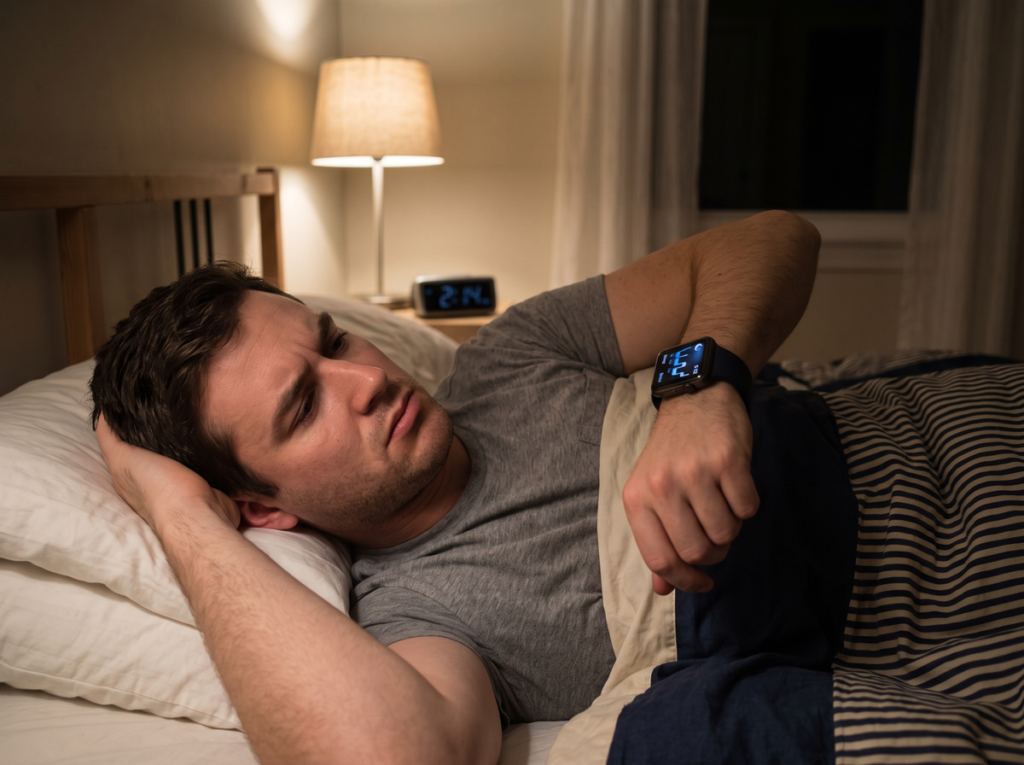
You stop being a sleeper and become an observer of yourself trying to sleep.
For someone already prone to insomnia or sleep anxiety, that additional layer of monitoring can become counterproductive.
A Healthier Way to Use Your Sleep Tracker
You don’t necessarily need to throw away your smartwatch or smart ring.
Instead, change the job you’ve assigned it.
1. Look for trends, not individual nights
One bad night doesn’t necessarily require an explanation.
Look at patterns across weeks rather than reacting to every fluctuation.
2. Pay attention to how you feel
Ask yourself:
Am I reasonably alert?
Can I function during the day?
Do I generally feel restored?
Those signals matter too.
3. Stop chasing sleep stages
If your device estimates that you got less deep sleep or REM sleep last night, resist the urge to immediately “fix” it.
Your body regulates sleep architecture automatically.
You don’t have to micromanage every stage.
4. Check the data once
Among the AASM recommendations for healthier sleep tracking are reviewing your sleep data in the morning rather than during the night and avoiding becoming overly focused on the results.
Look once if you want to.
Then move on with your day.
5. Don’t make major decisions from one data point
If something appears unusual, see whether it becomes a consistent pattern before redesigning your entire sleep routine around it.
6. Keep your routine flexible
A healthy sleep routine should tolerate dinner with friends, travel, a late movie, or the occasional disrupted night.
Flexibility is part of healthy sleep.
7. Remember what the tracker is for
The goal isn’t to improve the numbers.
The goal is to improve your sleep and your life.
If those goals start diverging, choose your life.
Try a Sleep-Tracking Reset
If you suspect your tracker is increasing your sleep anxiety, consider a simple experiment.
Take 7 to 14 days away from sleep tracking.
You don’t necessarily need to stop wearing your device if you use it for other purposes. Depending on the device, you may simply be able to stop checking the sleep dashboard or sleep score.
During the reset:
- don’t check sleep scores
- don’t calculate your sleep manually
- don’t analyze REM or deep sleep
- avoid looking at the clock during nighttime awakenings
- maintain a reasonably consistent wake time
- continue normal healthy sleep habits
- notice how you feel during the day
Most importantly, observe what happens psychologically.
Do you think about sleep less?
Does bedtime feel less pressured?
Are you less concerned about individual awakenings?
Do you judge your day less based on what supposedly happened the night before?
At the end of the experiment, you can decide whether sleep tracking genuinely adds something useful to your life.
You may choose to resume tracking with new boundaries.
Or you may discover that you sleep better when you know less.
The 7-Day Sleep Tracker Reset
For one week, make your body—not your score—the experiment.
Don’t check your nightly sleep data. Keep a consistent wake time and your usual healthy routine, but stop grading your sleep.
Each morning, ask only:
How do I feel today?
Then get on with your day.
At the end of the week, compare your anxiety, sleep effort, and daytime functioning—not your sleep score.
What If You Actually Aren’t Sleeping Well?
There is an important caution here.
Not every concern revealed by a sleep tracker is orthosomnia.
You may genuinely have poor sleep.
And dismissing every wearable warning as “just anxiety” would be as misguided as treating every tracker number as medical fact.
If you’re regularly struggling to fall asleep, waking for long periods, experiencing excessive daytime sleepiness, snoring loudly, waking up gasping or choking, or otherwise experiencing persistent sleep problems, consider discussing them with an appropriate health care professional.
The key distinction is this:
Use tracker data as a clue—not a diagnosis.
A clinician can consider your symptoms, medical history, sleep patterns, and, when appropriate, validated testing rather than relying on a consumer algorithm alone.
If your primary challenge is building healthier sleep habits and a less stressful relationship with sleep, you can also find a sleep coach for personalized support.
When Orthosomnia and Insomnia Overlap
For some people, sleep tracking may become part of a larger insomnia cycle.
You worry about sleep.
You try harder to control it.
You monitor whether your efforts are working.
You become frustrated when they don’t.
Bedtime gradually becomes associated with effort, evaluation, and wakefulness rather than sleep.
According to clinical practice guidelines from the American Academy of Sleep Medicine, CBT-I is strongly recommended for chronic insomnia in adults.
CBT-I is particularly relevant because it addresses many of the processes that can accompany orthosomnia: unhelpful beliefs about sleep, excessive sleep effort, maladaptive behaviors, and the association between bed and wakefulness.
If these patterns are contributing to ongoing sleep difficulties, learning more about CBT-I for insomnia can help you understand how this evidence-based approach works and the strategies it uses to break the insomnia cycle.
Sometimes improving sleep requires adding another technique.
Sometimes it requires removing the pressure to sleep perfectly.
Frequently Asked Questions
Is orthosomnia a real sleep disorder?
Orthosomnia is a term used in sleep medicine research to describe an unhealthy preoccupation with achieving ideal sleep, particularly through wearable sleep-tracking data. However, it is not currently recognized as a standalone sleep disorder diagnosis with universally accepted diagnostic criteria. Research into how orthosomnia should be defined and measured is ongoing.
Can sleep trackers cause insomnia?
Sleep trackers don’t automatically cause insomnia, and many people use them without problems. However, for some individuals, repeatedly monitoring and worrying about sleep data may increase sleep-related anxiety, sleep effort, or preoccupation. Those processes can interfere with sleep and may contribute to an insomnia cycle.
Are sleep trackers accurate?
Consumer sleep trackers can be useful for identifying general patterns, but accuracy varies by device, metric, algorithm, and individual. They generally estimate sleep using signals such as movement and heart rate rather than measuring the full range of physiological signals used during clinical polysomnography. Sleep-stage estimates deserve particular caution.
Should I stop wearing my sleep tracker?
Not necessarily. If tracking helps you recognize useful long-term patterns without causing anxiety, there may be no reason to stop. If your score controls your mood, makes you worry about sleep, or causes you to continually modify your behavior, try taking a break or limiting how often you review the data.
Why do I feel tired after my tracker says I slept well?
Sleep is only one factor affecting how you feel during the day. Stress, illness, mood, activity, medications, circadian timing, and other health factors can affect fatigue and alertness. Consumer sleep trackers are also imperfect estimators. A good score doesn’t guarantee that you’ll feel great, just as a poor score doesn’t guarantee that you’ll feel terrible.
Why do I feel fine until I see a bad sleep score?
Seeing negative sleep data can change your expectations about how you think you should feel. Instead of relying primarily on your own experience, you may begin interpreting your day through the tracker. If this happens repeatedly, consider checking your subjective energy and alertness before looking at the device—or experimenting with not checking it at all.
How can I stop obsessing over my sleep score?
Start by reducing the importance you assign to individual nights. Check data less frequently, focus on longer-term patterns, stop trying to optimize individual sleep stages, and consider a temporary tracking break. If anxiety about sleep persists or is contributing to insomnia, professional support or CBT-I may help.
Better Sleep Doesn’t Need a Perfect Score
Sleep tracking technology can teach us a lot.
It can reveal patterns we might otherwise miss, encourage healthier habits, and make sleep feel more tangible.
But no algorithm should have the power to tell you how you’re supposed to feel every morning.
Your sleep will fluctuate.
Your sleep stages will fluctuate.
Your routines will occasionally change.
Some nights will simply be better than others.
That isn’t failed sleep.
That’s human sleep.
If tracking helps you understand those patterns, use it.
If tracking makes you afraid of them, give yourself permission to step away.
Because ultimately, the best relationship with sleep may be one in which you don’t have to think about it quite so much.

Stone Evans, Founder of SleepCoaching.com
Stone Evans is the founder of SleepCoaching.com which has become one of the most popular destinations online for people seeking better sleep. Stone started developing this website after realizing his own sleep struggles and then beginning an intensive period of study (which included professional sleep coach training) and ongoing lifestyle changes to improve and optimize his sleep.
Now through in-depth articles from sleep experts around the world, the internet's leading and most comprehensive sleep coaching directory, quantitative sleep product reviews and Stone's personal daily sleep tracking journey, visitors to our website regularly report gaining information and insights that are helping them achieve better health, better sleep and a better quality of life.

