
Getting better sleep has become a goal people are willing to optimize almost like fitness. They track sleep scores, cool their bedrooms, take supplements, wear special glasses, tape their mouths, adjust their evening routines, and experiment with products designed to squeeze a little more recovery out of every night.
That growing trend has a name: sleepmaxxing.
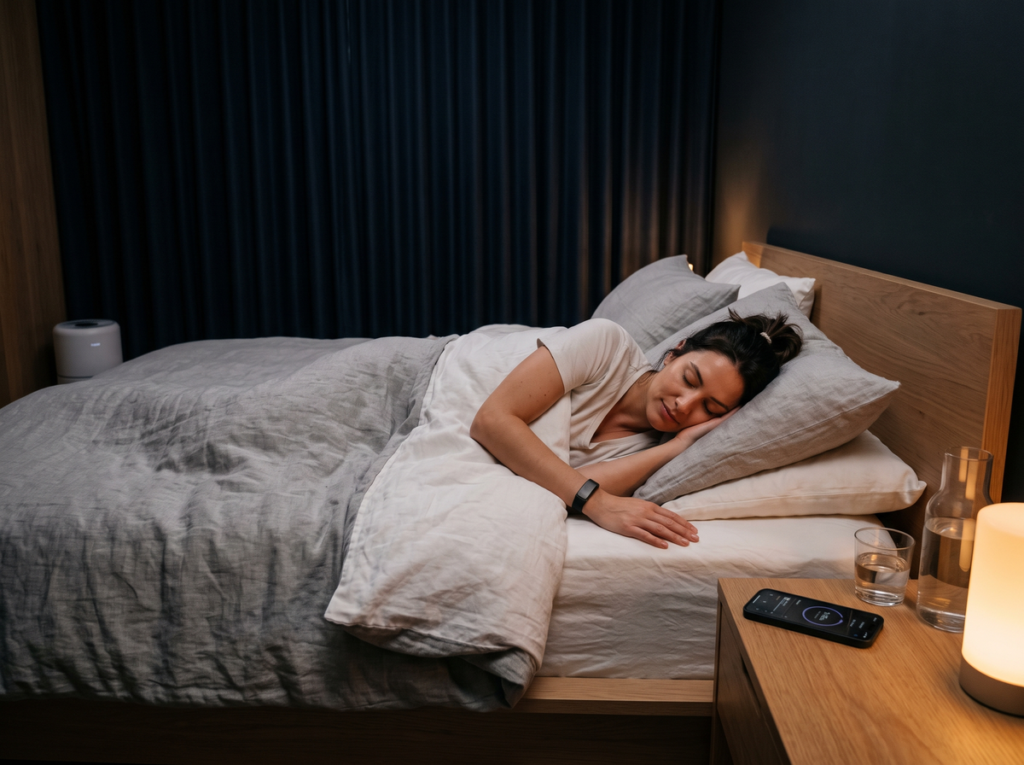
At its best, sleepmaxxing encourages people to take sleep seriously and build habits that support consistent, restorative rest. At its worst, it can turn bedtime into an elaborate optimization project where every number, product, and imperfect night becomes something else to worry about.
The good news is that effective sleepmaxxing doesn’t need to be complicated.
Some of the most useful strategies are also the least exciting: maintain a consistent sleep schedule, get enough sleep opportunity, use light to support your body clock, create a comfortable bedroom, and avoid habits that regularly interfere with sleep.
The challenge is separating those fundamentals from the growing collection of sleep hacks surrounding them.
This guide does exactly that.
Key Takeaways
- Sleepmaxxing is the practice of intentionally optimizing sleep through habits, environmental changes, tracking, products, supplements, and other sleep-related strategies.
- The strongest foundation isn’t a complicated collection of hacks. Consistent sleep timing, adequate sleep opportunity, morning light, regular movement, and a comfortable sleep environment deserve priority.
- Sleep trackers can be useful for identifying broad patterns, but consumer devices do not measure sleep with the same accuracy as clinical polysomnography.
- Popular sleepmaxxing practices such as magnesium, weighted blankets, and blue-light-blocking glasses have mixed or limited evidence and should not replace the basics.
- Mouth taping should not be treated as a harmless universal sleep hack. Evidence is limited, and it may be risky for people with nasal obstruction or certain breathing problems.
- Trying too hard to perfect sleep can become counterproductive. The goal is better sleep—not a perfect sleep score.
Table of Contents
What Is Sleepmaxxing?
Sleepmaxxing is an informal term for trying to maximize the quality, quantity, consistency, and restorative value of your sleep.
There is no official medical protocol called sleepmaxxing. Instead, the term grew out of online wellness and optimization culture and now describes a wide range of behaviors.
For one person, sleepmaxxing might mean keeping the bedroom cool and going to bed at the same time every night.
For another, it could involve a wearable sleep tracker, blackout curtains, magnesium, nasal strips, mouth tape, a weighted blanket, special glasses, temperature-controlled bedding, white noise, and a detailed nighttime routine.
That enormous range is why it helps to think about sleepmaxxing differently.
Rather than asking:
“What else can I add to my sleep routine?”
ask:
“What is most likely to meaningfully improve my sleep?”
That shift—from accumulating hacks to prioritizing fundamentals—is where sleepmaxxing becomes genuinely useful.
The Best Sleepmaxxing Starts With Sleep Regularity
Before buying another sleep product, look at your schedule.
Going to bed and waking up at roughly consistent times gives your circadian rhythm a predictable pattern. Your internal clock responds to recurring cues, and sleep timing is one of the most important parts of that daily rhythm.
Consistency doesn’t mean you need to be asleep at exactly 10:17 every night. Real life includes dinners, travel, weekends, children, work deadlines, and occasional late nights.
The goal is a reasonably stable pattern.
Sleep regularity is also becoming an increasingly interesting area of sleep research. A large prospective study using data from more than 60,000 UK Biobank participants found that greater day-to-day sleep regularity was associated with lower mortality risk and was a stronger predictor of mortality risk than sleep duration in that study.
That doesn’t mean regularity is the only thing that matters, or that the study proves an irregular schedule causes earlier death. It does reinforce an important idea: when you sleep may deserve attention alongside how long you sleep.
For many people, the simplest place to begin is with a consistent wake-up time. Once that anchor becomes stable, bedtime can follow your natural sleepiness while still allowing enough opportunity for sleep.
Give Yourself Enough Opportunity to Sleep
Optimizing sleep isn’t useful if your schedule simply doesn’t leave enough room for it.
Healthy adults generally need at least seven hours of sleep regularly, although individual sleep needs vary. Some people naturally need more.
This is an important distinction in sleepmaxxing culture.
You cannot reliably compensate for chronic sleep restriction with a better pillow, magnesium supplement, expensive wearable, colder mattress, or elaborate evening routine.
Start by asking a basic question:
Does my schedule consistently give me enough time to get the sleep I need?
If the answer is no, that’s the first optimization opportunity.
More time in bed isn’t always better, however. People with chronic insomnia can sometimes spend excessive time awake in bed trying to catch up on sleep. In CBT-I, techniques such as sleep restriction therapy deliberately address that pattern.
Sleep opportunity and time in bed therefore need context. Someone voluntarily sleeping five hours because of a packed schedule has a different problem from someone spending nine hours in bed but sleeping only six.
Use Light to Work With Your Body Clock
Light is one of the strongest environmental signals affecting your circadian rhythm.
Getting outside after waking gives your brain a clear daytime cue. This can be especially useful when you’re trying to establish a more consistent sleep-wake pattern.
You don’t need to turn morning light into another complicated optimization ritual. Open the curtains, step outside, walk the dog, drink your morning coffee outdoors, or take a short walk.
At the other end of the day, reducing very bright light and stimulating screen use before bed can help create a clearer transition toward nighttime.
This is where sleepmaxxing sometimes becomes unnecessarily rigid.
You may see recommendations to eliminate every screen hours before bedtime or wear blue-light-blocking glasses throughout the evening. Those strategies may be useful for some people, but the evidence for blue-light-filtering spectacle lenses improving sleep is not definitive.
A major Cochrane review found that the evidence regarding their effects on sleep quality was uncertain.
A simpler approach is to reduce unnecessary brightness and stimulation as bedtime approaches without becoming afraid of every photon emitted by your phone.
Make Your Bedroom Boring—in a Good Way
Your bedroom doesn’t need to look like a sleep laboratory.
It should simply make sleeping easy.
A good sleep environment is generally:
- Dark enough that light doesn’t repeatedly disturb you.
- Quiet enough that noise isn’t keeping you alert.
- Comfortable and appropriately cool.
- Equipped with a mattress and bedding that feel comfortable to you.
- Free from unnecessary interruptions whenever possible.
The CDC includes a quiet, relaxing, cool bedroom among its basic recommendations for better sleep habits.
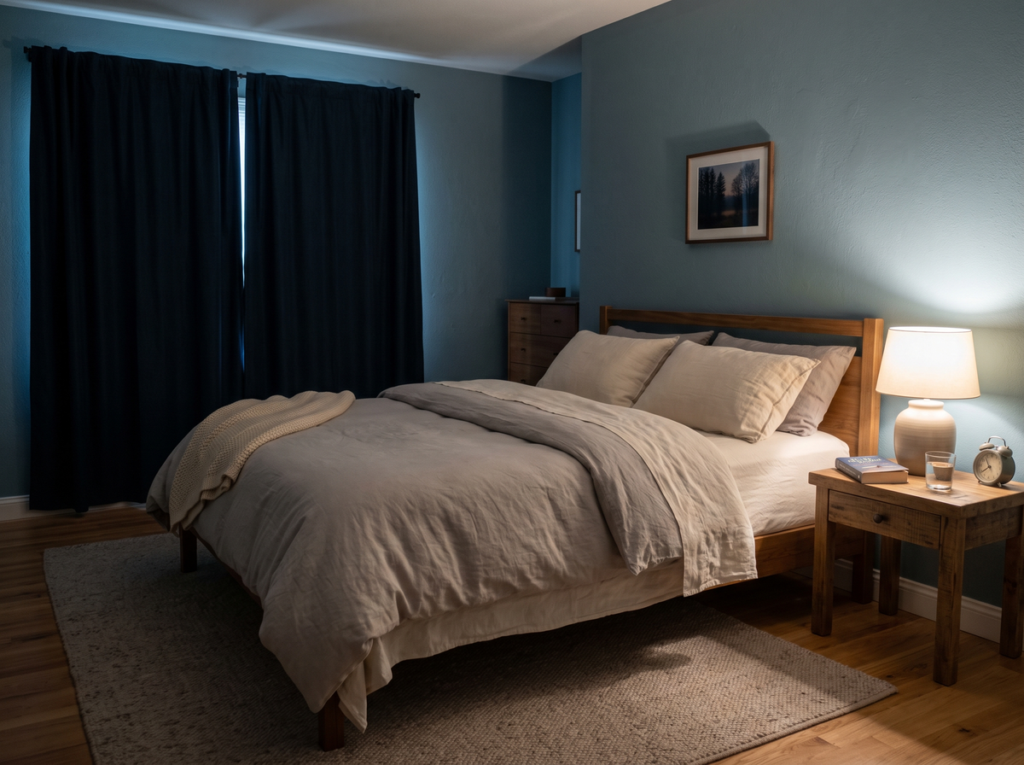
Temperature is worth paying attention to, but there is no need to become obsessed with finding one universal “perfect” bedroom temperature. Bedding, clothing, humidity, personal preference, health, age, and your individual thermal comfort all influence how warm or cool you feel.
If you’re regularly waking because you’re sweating or freezing, that’s useful information.
Fix the problem you’re actually experiencing rather than chasing a theoretically perfect number.
Sleep Trackers Are Tools, Not Judges
Wearable sleep technology fits naturally into sleepmaxxing.
A tracker can make invisible patterns visible. You might notice that your sleep timing changes dramatically on weekends, alcohol corresponds with worse nights, late meals affect your rest, or your sleep duration is shorter than you assumed.
That kind of pattern recognition can be useful.
But your wearable is not performing the same measurement as an overnight clinical sleep study.
A 2025 meta-analysis comparing consumer wrist-worn sleep trackers with polysomnography found significant differences in several important measurements, including total sleep time, sleep efficiency, sleep latency, and wakefulness after sleep onset.
The practical lesson isn’t to throw away your tracker.
It’s to use it for trends rather than perfection.
If your wearable says you received 52 minutes of deep sleep instead of your usual 68, you don’t need to redesign your entire day. Algorithms and estimates vary, and one night’s score isn’t a medical diagnosis.
Pay attention to longer-term patterns and combine the data with something surprisingly valuable:
How do you actually feel?
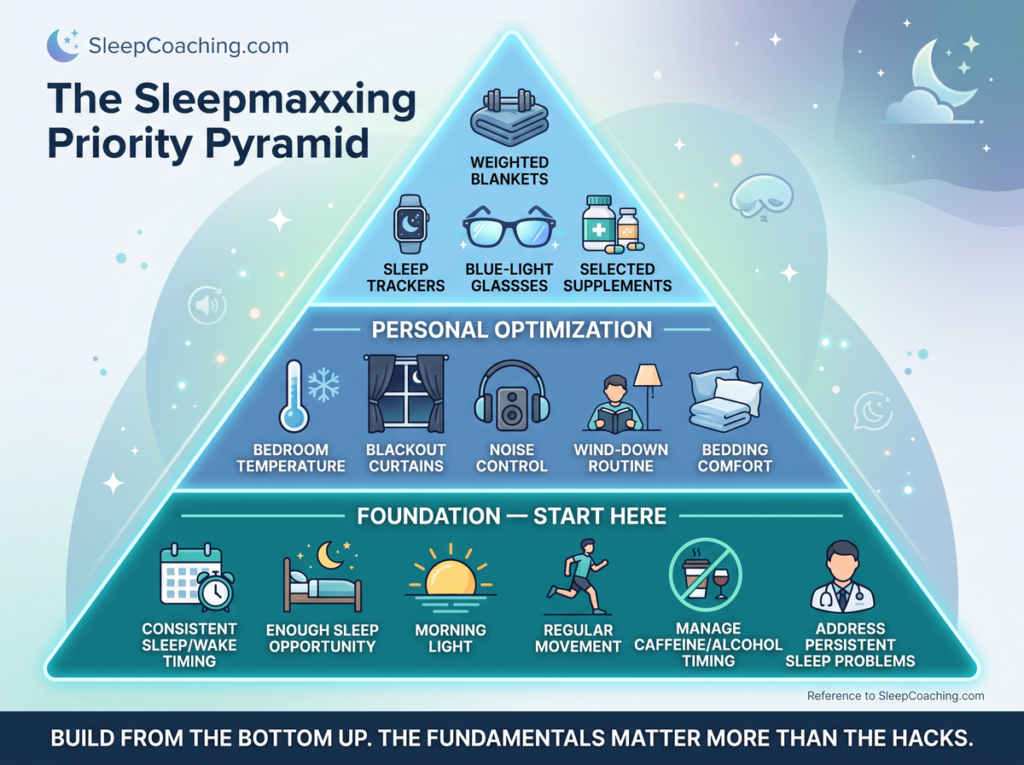
A useful way to think about sleepmaxxing is to build from the bottom up. Start with the fundamentals, personalize your sleep environment where it helps, and treat supplements, trackers, and other sleep hacks as optional extras rather than the foundation.
What About Magnesium for Sleep?
Magnesium has become one of the most recognizable supplements in the sleep optimization world.
There are plausible biological reasons magnesium could influence sleep, and some research has reported improvements in certain sleep outcomes. But the evidence is considerably less definitive than social media marketing can make it sound.
A systematic review examining magnesium and sleep found that observational studies generally suggested an association between magnesium status and sleep quality, while randomized clinical trial evidence was uncertain.
Another systematic review and meta-analysis focusing on older adults with insomnia found only three randomized controlled trials involving 151 participants. Although sleep-onset latency improved in the pooled analysis, the researchers rated the underlying evidence as low to very low quality.
That makes magnesium a good example of how to think about sleepmaxxing:
Promising or popular does not mean proven for everyone.
Supplements can also interact with medications or be inappropriate in some health situations. If you’re considering magnesium specifically to treat an ongoing sleep problem, discuss it with an appropriate healthcare professional rather than assuming more is better.
For a deeper look at the research, benefits, limitations, and safety considerations, see our guide to magnesium for sleep.
Do Weighted Blankets Help You Sleep?
Weighted blankets are another popular addition to sleep routines.
Some people simply find the pressure comforting, and that subjective comfort matters. If a weighted blanket helps you relax and you enjoy sleeping under it, there may be no need for a complicated scientific justification.
Claims that weighted blankets reliably treat insomnia deserve more caution.
Research has produced mixed results. Earlier systematic-review evidence found possible benefits for anxiety but insufficient evidence for insomnia. More recent reviews in specific psychiatric populations have found some encouraging results, while still highlighting limitations in the available research.
So weighted blankets belong in the optional part of sleepmaxxing, not the foundation.
They’re something you might enjoy—not something everyone needs to optimize sleep.
Mouth Taping Deserves More Caution
Few sleepmaxxing practices illustrate the gap between online popularity and established evidence better than mouth taping.
The idea is straightforward: tape the mouth closed during sleep to encourage nasal breathing.
That simplicity can make it sound harmless.
It isn’t appropriate to assume that it is harmless for everyone.
A 2025 systematic review examined 10 studies involving 213 patients and found limited evidence of benefit, while also identifying potential risks. The researchers specifically noted concern about indiscriminate use and the possibility of harm when nasal obstruction is present.
For a closer look at the evidence, potential benefits, and safety concerns, our guide to mouth taping for sleep explores what current research tells us—and why the reason behind nighttime mouth breathing matters.
If you’re regularly breathing through your mouth at night, snoring loudly, gasping, waking with a dry mouth, or having trouble breathing through your nose, the better question may not be “How do I keep my mouth closed?”
It may be:
“Why am I breathing this way while I sleep?”
Nasal obstruction and sleep-disordered breathing deserve appropriate evaluation rather than simply covering up a symptom with tape.
Mouth taping therefore belongs in a very different category from keeping your bedroom dark or maintaining a consistent wake time.
One is a broadly sensible sleep habit.
The other is an intervention with potential risks that deserves individualized consideration.
The Hidden Downside of Sleepmaxxing: Trying Too Hard to Sleep
There is an irony at the center of sleep optimization.
Sleep is important enough to improve, but it is also something you cannot completely control.
You can create conditions that support sleep. You cannot command yourself to become unconscious at exactly the right moment, remain asleep for precisely eight hours, achieve the perfect amount of deep sleep, and wake with a score of 100.
Trying harder can sometimes make sleep more difficult.
A disappointing tracker score can make you worry about how you’ll perform that day. That worry follows you into the evening. You start adding more rules to your routine because tonight’s sleep suddenly feels especially important.
Then bedtime becomes a test.
For people prone to insomnia, that pressure can be counterproductive. The bed can gradually become associated with monitoring, effort, frustration, and wakefulness rather than sleep.
This is why some of the best sleep coaching sounds almost anti-sleepmaxxing:
Create good conditions for sleep, then allow sleep to happen.
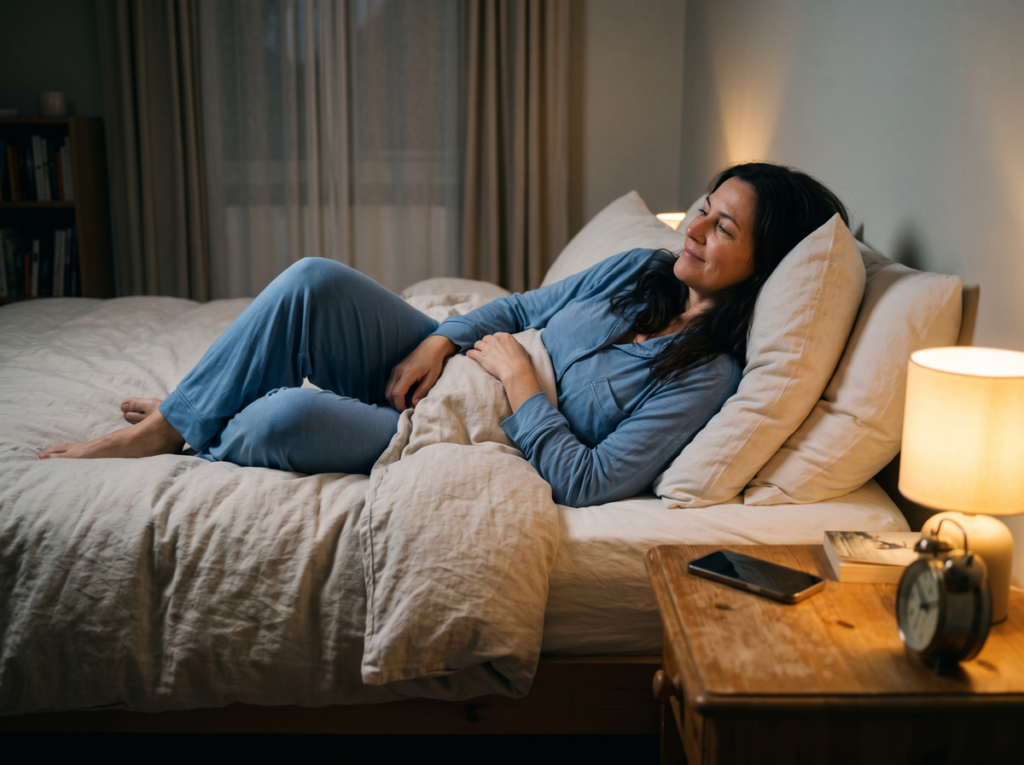
If you’re awake in bed for a prolonged period and becoming frustrated, stimulus control is one CBT-I strategy designed to rebuild the association between bed and sleep.
Likewise, repeatedly checking the time during a difficult night can increase pressure and mental calculation.
A Simpler Sleepmaxxing Routine That Actually Makes Sense
If you want to try sleepmaxxing, start with a short list rather than a shopping list.
Morning:
Wake at a reasonably consistent time. Get some natural light. Move your body and begin your day rather than lingering in bed trying to collect more sleep.
Daytime:
Exercise regularly, eat normally, and pay attention to caffeine timing. If caffeine affects your sleep, move your last serving earlier rather than relying on another nighttime intervention to counteract it.
Evening:
Give your brain a transition out of the day. Reduce unnecessary stimulation, dim overly bright lighting, and choose activities that help you unwind.
Bedroom:
Make the room dark, quiet, comfortable, and cool enough for you. Solve specific problems—noise, light, heat, an uncomfortable mattress—before adding gadgets that address problems you don’t have.
Bedtime:
Go to bed when you’re ready for sleep rather than because your optimization schedule says you must be asleep immediately.
Morning again:
Evaluate patterns over time. Don’t declare the experiment a success or failure because of one sleep score.
That’s enough to build a very strong foundation.
When Sleep Hacks Aren’t Enough
Sleepmaxxing is most useful when it improves habits around otherwise healthy sleep.
It becomes less useful when you’re trying to self-optimize your way around an untreated sleep disorder.
Talk with a healthcare professional or sleep specialist if you regularly experience symptoms such as:
- Loud, persistent snoring.
- Gasping or choking during sleep.
- Witnessed pauses in breathing.
- Severe daytime sleepiness.
- An uncontrollable urge to move your legs at night.
- Persistent difficulty falling asleep or staying asleep.
- Sleep problems that significantly interfere with your daytime life.
Someone with obstructive sleep apnea does not need a better collection of sleep hacks. They need appropriate evaluation and treatment.
Likewise, chronic insomnia often responds to a structured treatment such as cognitive behavioral therapy for insomnia rather than an endlessly expanding bedtime routine.
Frequently Asked Questions
What does sleepmaxxing mean?
Sleepmaxxing means intentionally trying to improve or maximize sleep quality, duration, consistency, or recovery. It can include evidence-based sleep habits as well as products, supplements, wearables, environmental changes, and viral sleep hacks.
Does sleepmaxxing actually work?
Some sleepmaxxing practices can support better sleep, particularly consistent sleep timing, adequate sleep opportunity, morning light, regular exercise, and a comfortable sleep environment. Other popular practices have limited or mixed evidence. Sleepmaxxing works best when you prioritize fundamentals rather than assuming every sleep hack is beneficial.
What are the best sleepmaxxing techniques?
Start with a consistent sleep-wake schedule, enough opportunity to sleep, morning light, regular daytime movement, sensible caffeine and alcohol timing, and a dark, quiet, comfortable bedroom. Additional products or interventions should solve a specific problem rather than simply make your routine more complicated.
Do I need a sleep tracker for sleepmaxxing?
No. A sleep tracker can help reveal patterns, but it isn’t necessary for healthy sleep. Consumer wearables also have limitations compared with clinical sleep measurements, so individual sleep-stage estimates and nightly scores should not be treated as precise medical data.
Is mouth taping a good sleepmaxxing technique?
Mouth taping should not be treated as a universally safe sleep hack. Research remains limited, and there may be risks for people with nasal obstruction or certain breathing problems. Persistent mouth breathing, snoring, gasping, or difficulty breathing through your nose deserves appropriate evaluation.
Is magnesium good for sleepmaxxing?
Magnesium may influence sleep, and some research has found potential benefits, but the clinical evidence remains limited and inconsistent. It should be viewed as an optional intervention rather than a substitute for basic sleep habits or appropriate treatment for an ongoing sleep problem.
Can sleepmaxxing make sleep worse?
Yes, particularly if optimization turns into anxiety about achieving perfect sleep. Constantly monitoring sleep scores, adding rigid bedtime rules, or worrying about every imperfect night can increase sleep-related pressure. Good sleep habits should support sleep without making bedtime feel like a performance test.
The Best Sleepmaxxing May Be Doing Less
Sleep deserves attention.
That may be the most valuable idea behind the entire sleepmaxxing trend. In a culture that often celebrates sacrificing sleep for productivity, treating sleep as an important part of health is a positive change.
But taking sleep seriously doesn’t require turning it into a nightly engineering project.
Start with the fundamentals. Keep your schedule reasonably consistent. Give yourself enough opportunity to sleep. Use morning light. Move during the day. Create a comfortable bedroom. Pay attention to patterns without demanding perfection.
Then solve actual problems one at a time.
A blackout curtain makes sense if light enters your bedroom. A cooler sleep environment makes sense if you’re waking up hot. A tracker may be useful if you enjoy observing long-term patterns.
You don’t need every sleep hack simply because it exists.
The goal of sleepmaxxing isn’t to become better at managing sleep. It’s to create conditions where you can think about sleep less and sleep well more often.

Stone Evans, Founder of SleepCoaching.com
Stone Evans is the founder of SleepCoaching.com which has become one of the most popular destinations online for people seeking better sleep. Stone started developing this website after realizing his own sleep struggles and then beginning an intensive period of study (which included professional sleep coach training) and ongoing lifestyle changes to improve and optimize his sleep.
Now through in-depth articles from sleep experts around the world, the internet's leading and most comprehensive sleep coaching directory, quantitative sleep product reviews and Stone's personal daily sleep tracking journey, visitors to our website regularly report gaining information and insights that are helping them achieve better health, better sleep and a better quality of life.

