

Magnesium has become one of the most popular supplements in the search for better sleep.
Scroll through social media or browse the sleep aisle at almost any store and you will find magnesium promoted as a way to relax, fall asleep faster, sleep more deeply, and wake up feeling restored. Magnesium glycinate in particular has developed a reputation as a simple nighttime sleep aid.

But does magnesium for sleep actually work?
The answer is more interesting than either the hype or the skepticism suggests.
Magnesium is an essential mineral involved in hundreds of processes throughout the body, including nerve signaling and muscle function. There are also plausible biological reasons that adequate magnesium could support healthy sleep.
At the same time, magnesium isn’t a sleeping pill, and the research supporting supplementation is still relatively limited. The newest evidence suggests that it may produce modest improvements for some people—possibly especially when magnesium intake is already low.
So rather than asking whether magnesium makes you sleep, a better question may be:
Could magnesium help remove one small obstacle standing between you and better sleep?
That distinction matters.
Key Takeaways
- Magnesium is an essential mineral involved in normal nerve and muscle function and several biological processes related to sleep.
- Research suggests magnesium supplementation may modestly improve sleep or insomnia symptoms in some people, but the evidence is not strong enough to consider it a proven insomnia treatment.
- A recent randomized controlled trial found a small improvement in insomnia severity after four weeks of magnesium bisglycinate.
- Magnesium may be more useful when dietary magnesium intake is low rather than when someone already gets enough.
- Magnesium glycinate or bisglycinate is popular for nighttime use, but there isn’t convincing evidence that one form is universally the “best magnesium for sleep.”
- Food sources such as pumpkin seeds, almonds, spinach, beans, and whole grains can help increase magnesium intake without relying on supplements.
- More magnesium is not necessarily better. Supplements can cause gastrointestinal side effects, interact with medications, and present additional risks for people with impaired kidney function.
- Persistent insomnia deserves attention to the underlying cause rather than relying on a supplement alone.
Table of Contents
What Is Magnesium?
Magnesium is an essential mineral your body cannot produce on its own.
Understanding magnesium and its role in the body starts with recognizing how widely this mineral is used. It helps regulate muscle and nerve function, blood glucose, blood pressure, and processes involved in making protein, bone, and DNA.
That means magnesium isn’t primarily a “sleep nutrient.” Your body needs it throughout the day for basic physiological functioning.
Adults generally need somewhere around 310 to 420 mg of magnesium per day depending on age and sex, with needs differing during pregnancy. Rather than coming exclusively from supplements, magnesium naturally occurs in foods including leafy green vegetables, legumes, nuts, seeds, and whole grains.
Sleep enters the picture because some of the systems influenced by magnesium are also involved in how the brain and body transition between wakefulness and sleep.
How Magnesium May Affect Sleep
Sleep isn’t controlled by a single chemical or nutrient.
It emerges from an interaction between your circadian rhythm, sleep drive, nervous system, hormones, environment, behavior, health, and psychological state.
Magnesium may influence several pieces of that system.
Research has connected magnesium with regulation of neuronal excitability and processes involving GABA and melatonin. A 2026 review of nutritional influences on sleep describes magnesium as one of several nutrients capable of influencing sleep-related neurobiological pathways.
That biological plausibility is important—but it shouldn’t be confused with proof that taking a magnesium capsule will improve someone’s sleep.
Think about it this way:
Magnesium may help create conditions that support sleep. It doesn’t necessarily create sleep itself.
If your body isn’t getting enough magnesium, correcting that problem could potentially help normal physiological processes work more effectively.
But if your insomnia is being driven by anxiety about sleep, an inconsistent circadian rhythm, untreated sleep apnea, excessive time in bed, caffeine, pain, medication, or another underlying problem, adding magnesium may do very little.
That is one reason experiences with magnesium vary so dramatically.
Does Magnesium for Sleep Actually Work?
This is where the evidence becomes more nuanced.
Magnesium has been studied for sleep for years, but much of the research has involved relatively small groups, different forms and doses of magnesium, subjective measures of sleep, or specific populations.
A 2021 systematic review of magnesium supplementation for insomnia in older adults examined three randomized controlled trials involving 151 participants.
The pooled results suggested that people receiving magnesium fell asleep about 17 minutes faster than those receiving placebo. The improvement in total sleep time, however, was not statistically significant.
Just as importantly, the researchers rated the available evidence as low to very low quality and concluded that better studies were needed.
That’s promising enough to keep studying magnesium.
It isn’t strong enough to declare magnesium a proven sleep treatment.
Newer Research Adds an Important Piece
More recent research has made the picture a little more interesting.
A 2025 randomized, placebo-controlled trial of magnesium bisglycinate studied 155 adults between ages 18 and 65 who reported poor sleep. Participants received either magnesium bisglycinate providing 250 mg of elemental magnesium per day or placebo for four weeks.
The magnesium group experienced a greater reduction in Insomnia Severity Index scores than the placebo group.
But there is an important qualifier: the effect was small.
Perhaps the most interesting finding came from exploratory analyses. Participants reporting lower dietary magnesium intake appeared to experience greater improvements.
That doesn’t prove magnesium only works when someone has low intake. But it supports a very sensible possibility:
Magnesium supplementation may matter more when magnesium is something your body actually needs.
That is much different from assuming that everyone who wants better sleep should take it.
Low Magnesium and Poor Sleep May Be Connected
Researchers have also looked at magnesium intake and magnesium status outside clinical trials.
A 2024 population study involving more than 20,000 adults found associations between a measure of magnesium depletion and certain sleep problems, although it did not establish that magnesium deficiency caused those problems.
Another study of dietary magnesium intake and sleep duration involving more than 21,000 adults found that higher magnesium intake from food was associated with normal sleep duration, while supplemental magnesium intake wasn’t significantly associated with sleep duration or self-reported sleep disorders.
These kinds of observational studies can’t tell us that eating more magnesium will fix poor sleep.
People who eat diets rich in magnesium may also eat better overall, exercise more, or have other habits associated with healthier sleep.
Still, when combined with what we know about magnesium physiology and supplementation trials, they reinforce an important idea:
Getting enough magnesium matters. Taking extra magnesium is a different question.
What Is the Best Magnesium for Sleep?
This may be the most confusing part of shopping for magnesium.
You’ll encounter magnesium glycinate, bisglycinate, citrate, oxide, chloride, L-threonate, malate, and other forms—often accompanied by very confident claims about which one is “best” for sleep.
The research doesn’t justify quite that much certainty.
Magnesium Glycinate and Bisglycinate
Magnesium glycinate is magnesium bound to the amino acid glycine. Magnesium bisglycinate generally refers to magnesium bound to two glycine molecules, although supplement labeling and terminology aren’t always perfectly consistent.
It has become one of the most popular choices for nighttime supplementation because it is generally considered relatively well tolerated, and glycine itself has been studied separately for possible effects on sleep.
Importantly, the recent randomized trial showing modest improvements in insomnia symptoms used magnesium bisglycinate.
That gives this form more direct sleep-related evidence than marketing alone.
But it still doesn’t establish that magnesium glycinate or bisglycinate is superior to every other form for sleep.
Magnesium Citrate
Magnesium citrate is relatively well absorbed and widely available.
It can also have a laxative effect, which may be useful in some situations but isn’t necessarily something you want your bedtime routine to become known for.
If gastrointestinal effects disrupt your night, any theoretical sleep benefit quickly becomes less appealing.
Magnesium Oxide
Magnesium oxide contains a relatively high amount of elemental magnesium but is generally less bioavailable than several other forms.
It is also more likely to produce gastrointestinal effects in some people.
Interestingly, some earlier insomnia research used magnesium oxide, meaning it shouldn’t simply be dismissed as a form that “doesn’t work.”
Magnesium L-Threonate
Magnesium L-threonate receives substantial attention because it has been developed to increase magnesium delivery to the brain.
You may see claims that this automatically makes it the best form for sleep or cognitive health.
That’s a bigger conclusion than the available sleep research currently supports.
If a supplement is significantly more expensive, evidence should justify that difference—not simply a more impressive-sounding mechanism.
So Which Magnesium Should You Choose?
For someone who has discussed supplementation with a healthcare professional and wants to try magnesium specifically in relation to sleep, magnesium glycinate or bisglycinate is a reasonable option because of its tolerability and emerging direct evidence.
But there is no established winner that guarantees better sleep.
The label matters less than the bigger questions:
Are you getting enough magnesium?
Why are you sleeping poorly?
And is supplementation actually addressing that problem?
How Much Magnesium Should You Take for Sleep?
This is another place where internet advice can become misleading.
There is no universally established magnesium dose specifically for sleep.
The 2025 magnesium bisglycinate trial used 250 mg of elemental magnesium per day. Earlier studies have used other forms and doses, making direct comparisons difficult.
Pay attention to the words elemental magnesium when reading a supplement label.
The weight of a magnesium compound isn’t necessarily the amount of magnesium your body is actually receiving.
The NIH sets the upper limit for magnesium from supplements at 350 mg per day for adults unless a healthcare professional recommends otherwise. That limit does not include magnesium naturally present in foods.
This is one reason blindly copying someone else’s supplement routine isn’t a good strategy.
More is not automatically better.
When Should You Take Magnesium for Sleep?
You will frequently see recommendations to take magnesium 30 minutes, one hour, or two hours before bed.
There isn’t strong evidence establishing one perfect bedtime window.
If magnesium is being used as part of a nighttime routine, taking it sometime in the evening may be convenient. Consistency and tolerability are probably more important than trying to identify the perfect minute.
It is also worth remembering that magnesium isn’t like a conventional sedative.
You shouldn’t necessarily expect to swallow a capsule and suddenly become sleepy.
If supplementation helps because your magnesium intake was inadequate, the benefit may be subtler and may emerge over time rather than during the first night.
That makes magnesium a poor candidate for the nightly experiment:
“I took it at 10:03. Why am I still awake at 10:47?”
That kind of monitoring can actually increase sleep effort.
If you find yourself repeatedly checking the time or evaluating whether a supplement is “working” while lying in bed, our guide on how to stop clock watching explains why that habit can make sleep harder.
Magnesium-Rich Foods May Be the Better Starting Point
Before turning magnesium into another bedtime supplement, look at your diet.
Magnesium occurs naturally in many nutrient-dense foods, including:
- Pumpkin seeds
- Chia seeds
- Almonds
- Cashews
- Peanuts
- Spinach and other leafy greens
- Black beans and other legumes
- Whole grains
- Avocado
- Some fortified foods
Some of the best food sources of magnesium include nuts, seeds, legumes, whole grains, and green leafy vegetables.

This approach has an advantage supplements cannot completely replicate.
You aren’t just getting magnesium.
You’re improving the nutritional quality of your diet while receiving fiber, healthy fats, protein, vitamins, minerals, and other beneficial compounds at the same time.
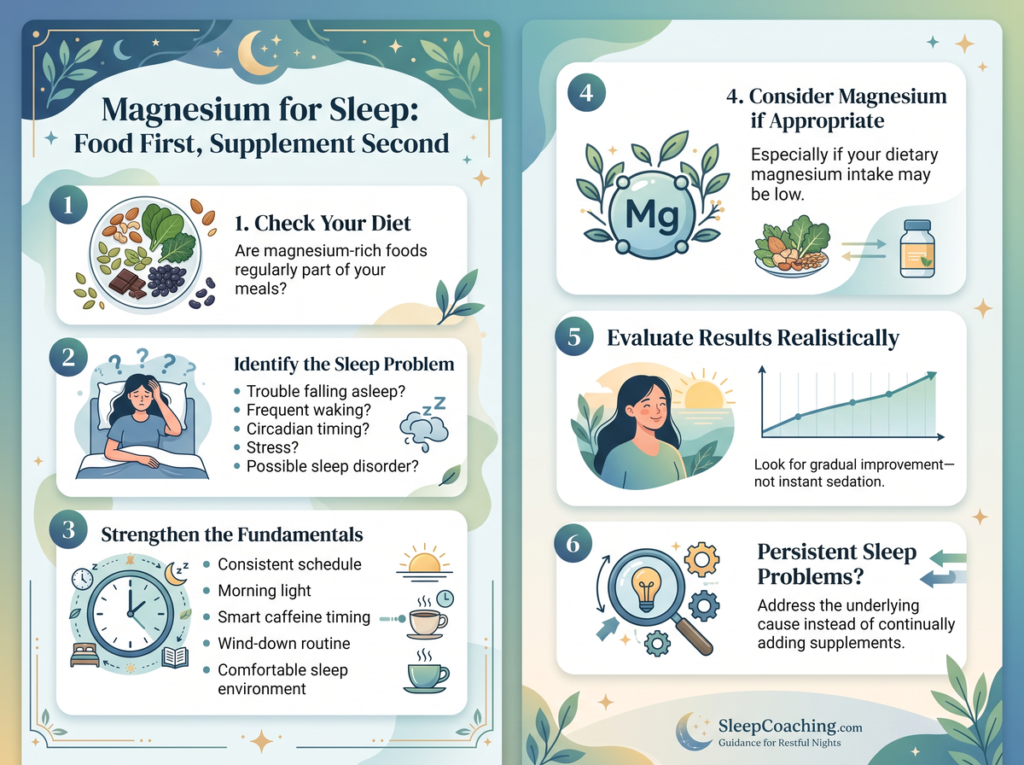
If you’re considering magnesium for sleep, a simple step-by-step approach can help you decide where it fits into the bigger picture.
Magnesium Isn’t a Substitute for Treating Insomnia
This distinction is especially important.
If you’ve had trouble falling asleep or staying asleep for months, magnesium shouldn’t become another attempt to force sleep to happen.
Chronic insomnia often involves a learned cycle.
You sleep poorly, start worrying about the next night, spend longer in bed trying to compensate, monitor how tired you feel, become increasingly focused on sleep, and gradually turn bedtime into something your brain approaches with effort rather than ease.
Magnesium doesn’t undo that conditioning.
For chronic insomnia, cognitive behavioral therapy for insomnia (CBT-I) remains the first-line treatment because it addresses the behavioral and cognitive processes that can perpetuate sleep difficulties.
If your sleep difficulty has become persistent, our guide to cognitive behavioral therapy for insomnia (CBT-I) explains why this approach is considered a first-line treatment and how its different components work together.
Magnesium can potentially be supportive.
It shouldn’t distract you from the intervention most likely to address the actual cause of the problem.
Who Might Be More Likely to Benefit From Magnesium?
We can’t reliably predict who will sleep better after taking magnesium.
Still, the research gives us some reasonable clues.
Someone with low dietary magnesium intake may have more room to benefit than someone whose intake is already adequate. The exploratory findings from the 2025 bisglycinate trial are particularly interesting in this regard.
Certain medical conditions and medications can also contribute to magnesium deficiency.
According to the NIH, prolonged low intake can eventually result in deficiency, while gastrointestinal diseases, type 2 diabetes, long-term alcohol use, and certain medications can affect magnesium status.
Symptoms of significant magnesium deficiency can include fatigue, weakness, nausea, muscle cramps, numbness, tingling, and—in severe cases—abnormal heart rhythms. Those symptoms aren’t specific enough to diagnose a deficiency yourself.
If deficiency is a genuine concern, discuss it with a healthcare professional rather than treating poor sleep as proof that you need magnesium.
When Magnesium for Sleep Deserves More Caution
“Natural” doesn’t mean risk-free.
Magnesium from normal foods is generally not a concern for healthy people because the kidneys eliminate excess magnesium.
Supplements are different.
High supplemental intakes can cause diarrhea, nausea, and abdominal cramping. Very high doses can cause serious toxicity. The risk is particularly important for people with impaired kidney function because their ability to remove excess magnesium may be reduced.
Magnesium supplements can interact with certain medications, including some antibiotics and medications used for osteoporosis. Diuretics and long-term use of certain acid-reflux medications can also affect magnesium status.
Talk with a doctor or pharmacist before supplementing if you:
- Have kidney disease or reduced kidney function
- Take prescription medications
- Are pregnant or breastfeeding
- Have a medical condition affecting nutrient absorption
- Are already taking supplements containing magnesium
- Are considering doses above established supplemental limits
And if your sleep problems include loud snoring, gasping or choking during sleep, significant daytime sleepiness, or other possible signs of sleep apnea, magnesium isn’t the appropriate solution.
The breathing problem needs to be evaluated.
A Smarter Way to Try Magnesium for Sleep
If magnesium seems appropriate for you after considering diet, health conditions, medications, and professional guidance, treat it as a small experiment rather than a sleep rescue mission.
Keep the rest of your routine reasonably stable.
Choose a consistent amount and timing rather than changing both every night. Avoid simultaneously adding several other sleep supplements, because then you won’t know what helped—or what caused a side effect.
Most importantly, judge the result over time.
Ask:
Am I falling asleep somewhat more easily?
Am I spending less time awake during the night?
Do I feel better during the day?
Is there a noticeable difference when I look back over several weeks?
Don’t demand that magnesium “knock you out.”
That expectation misunderstands both magnesium and sleep.
If you find yourself lying in bed trying harder and harder to make sleep happen, stimulus control for insomnia offers a different approach: rebuilding the connection between your bed and sleep rather than increasing the effort surrounding bedtime.
Frequently Asked Questions
Does magnesium really help you sleep?
Possibly, but the effect appears modest and may vary considerably from person to person. A 2025 randomized controlled trial found a small improvement in insomnia severity with magnesium bisglycinate, while earlier research has produced promising but limited results. Magnesium may be more useful for people whose magnesium intake is relatively low.
What is the best magnesium for sleep?
There isn’t enough evidence to identify one form as universally best. Magnesium glycinate or bisglycinate is a reasonable choice because it is generally well tolerated and magnesium bisglycinate has been tested in a recent randomized sleep trial. That doesn’t prove it is superior to every other form.
Is magnesium glycinate better for sleep?
Magnesium glycinate has become popular for sleep because magnesium is combined with glycine and tends to be relatively well tolerated. Recent clinical evidence involving magnesium bisglycinate is encouraging, but the measured benefit was modest. Claims that magnesium glycinate is definitively the best form for sleep go beyond the current evidence.
How much magnesium should I take for sleep?
There is no universally established dose specifically for sleep. One recent trial used 250 mg of elemental magnesium per day. The NIH’s upper limit for magnesium from supplements and medications is 350 mg per day for adults unless otherwise directed by a healthcare professional. Magnesium obtained naturally from food isn’t included in that supplemental limit.
How long before bed should I take magnesium?
There is no scientifically established perfect time. Many people take magnesium during the evening because it fits naturally into a bedtime routine. Consistency and tolerability are likely more important than taking it at an exact number of minutes before sleep.
How long does magnesium take to work for sleep?
Don’t necessarily expect an immediate sedative effect. Clinical studies have generally evaluated supplementation over weeks rather than a single night. If magnesium helps by correcting inadequate intake, improvements may be gradual.
Can you take magnesium every night?
Magnesium is an essential nutrient, but whether nightly supplementation is appropriate depends on the dose, your diet, kidney function, medications, health conditions, and other supplements you take. Long-term supplementation is worth discussing with a healthcare professional rather than assuming that nightly use is automatically beneficial.
Can magnesium make sleep worse?
Some people experience gastrointestinal discomfort, diarrhea, or nausea from magnesium supplements, which can certainly interfere with sleep. Individual responses also vary. If your sleep consistently worsens after starting a supplement, don’t assume you need to increase the dose.
Magnesium May Help, but Better Sleep Is Bigger Than a Supplement
Magnesium deserves neither miracle status nor dismissal.
It is an essential nutrient, and getting enough of it matters for your health. There are plausible biological connections between magnesium and sleep, older clinical trials have produced encouraging findings, and newer research suggests magnesium bisglycinate may modestly improve insomnia symptoms in some adults.
That’s enough evidence to take magnesium seriously.
It isn’t enough evidence to build your entire sleep strategy around it.
If your magnesium intake is low, improving your diet or appropriately supplementing may remove one obstacle to better sleep. If you’re already getting enough magnesium, taking more may accomplish very little.
And if your real problem is chronic insomnia, sleep apnea, circadian disruption, stress, pain, or another sleep disorder, magnesium doesn’t make that problem disappear.
The most useful way to think about magnesium is therefore much simpler:
Better sleep rarely comes from finding one perfect supplement. It comes from giving your body—and your brain—the conditions they need to sleep well.

Stone Evans, Founder of SleepCoaching.com
Stone Evans is the founder of SleepCoaching.com which has become one of the most popular destinations online for people seeking better sleep. Stone started developing this website after realizing his own sleep struggles and then beginning an intensive period of study (which included professional sleep coach training) and ongoing lifestyle changes to improve and optimize his sleep.
Now through in-depth articles from sleep experts around the world, the internet's leading and most comprehensive sleep coaching directory, quantitative sleep product reviews and Stone's personal daily sleep tracking journey, visitors to our website regularly report gaining information and insights that are helping them achieve better health, better sleep and a better quality of life.

