

When sleep won’t come, spending more time in bed can feel like the obvious solution. Go to bed earlier, sleep later, and give yourself every possible opportunity to catch up.
For many people with chronic insomnia, however, those extra hours can have the opposite effect. More time in bed can turn into more time awake—watching the clock, worrying about sleep, and trying increasingly hard to make sleep happen.
Sleep restriction therapy takes a different approach. It temporarily limits your time in bed to more closely match the amount of sleep you are actually getting, then gradually expands that window as your sleep becomes more consistent.

The idea can sound counterintuitive, especially when you’re already tired. But sleep restriction therapy is a well-established component of cognitive behavioral therapy for insomnia (CBT-I) and is designed to help make sleep more consolidated and your time in bed more restful.
This article explains how sleep restriction therapy works, how sleep efficiency is calculated, what the first few weeks may feel like, and why safety and professional guidance matter.
This is educational information, not a personal treatment plan. A qualified CBT-I clinician can help you apply sleep restriction therapy safely and adapt it to your health, work, and daily life.
Key Takeaways
- Sleep restriction therapy temporarily limits time in bed to more closely match the amount of sleep you are actually getting, then gradually expands the sleep window as sleep becomes more consistent.
- Start with a one- to two-week sleep diary, a consistent wake-up time, and a conservative schedule based on your average total sleep time—not a guess.
- Use your average sleep efficiency to guide small, planned adjustments rather than changing your bedtime after one difficult night.
- Feeling more tired at first can happen, but dangerous drowsiness should never be ignored. Do not drive or perform hazardous tasks if your alertness is impaired.
- Professional CBT-I guidance is especially important if you have sleep apnea, bipolar disorder, a seizure disorder, complex medical conditions, take medications that affect alertness, or have safety-sensitive work.
How Sleep Restriction Therapy Helps Chronic Insomnia
Despite its name, sleep restriction therapy is not about deliberately depriving yourself of the sleep you need. The goal is to reduce the amount of time you spend awake in bed, not to create ongoing sleep deprivation or leave you chronically exhausted.
Insomnia can create an unhelpful pattern. After sleeping poorly, you may go to bed earlier in hopes of catching up. You might stay in bed later the next morning or spend more time lying down trying to rest.
Although understandable, this can gradually weaken the connection between your bed and sleep. Instead of signaling rest, getting into bed may begin to trigger alertness, frustration, or worry about whether you’ll sleep.
Sleep restriction therapy works on this pattern by establishing a smaller, more consistent period for sleep. Spending more time awake during the day also builds homeostatic sleep drive—the natural pressure to sleep that increases the longer you have been awake.
With stronger sleep drive and less time spent awake in bed, falling asleep may become easier and nighttime awakenings may become shorter. If frequent awakenings are a concern, understanding more about waking up during the night can also help you identify possible causes and helpful next steps.
Timing matters, too. A consistent morning wake-up time provides your circadian rhythm with a steady daily cue. Together, the fixed wake time and defined sleep period create a more predictable pattern instead of a long, uncertain night.
Stanford Health Care’s overview of sleep restriction describes the method as a way to reduce extended periods of wakefulness during the night and gradually encourage more consolidated sleep.
The early goal isn’t to achieve a perfect number of hours. It’s to spend more of your time in bed actually sleeping.
Sleep restriction is typically combined with other CBT-I strategies. These can include addressing unhelpful beliefs about sleep, creating a consistent wind-down routine, and strengthening the association between bed and sleep. Together, these approaches address both the behaviors and the mental patterns that can keep insomnia going.
Start With a Sleep Diary, Not a Guess
Before changing your sleep schedule, you need a realistic picture of what your sleep currently looks like.
For at least one to two weeks, keep a simple sleep diary. A paper notebook works fine, and many CBT-I programs also provide digital sleep logs.
Each morning, record:
- When you got into bed and when you got out of bed.
- Your best estimate of when you fell asleep.
- Approximately how long you were awake during the night.
- When you woke up for the day.
- Any naps, alcohol, caffeine, medication changes, illness, or other factors that may have affected your sleep.
Don’t worry about making the diary perfect. The goal is to identify patterns, not account for every minute. Sleep diaries generally rely on your estimates rather than wearable data, and your typical pattern becomes clearer when you look across multiple nights.

Once you have enough information, calculate your average total sleep time. This is the estimated amount of time you were actually asleep—not simply the amount of time you spent in bed.
For example, suppose you regularly spend eight and a half hours in bed but estimate that you sleep for about six hours. A clinician might use an interval near six hours as a starting point, subject to appropriate safety limits and your individual circumstances.
Next, choose a wake-up time that you can maintain consistently, including on weekends whenever practical. Consider your job, school, commute, caregiving responsibilities, and other morning demands.
If your wake-up time is 6:30 a.m. and your prescribed sleep interval is six hours, for example, your scheduled bedtime would be 12:30 a.m.
The wake-up time acts as the anchor. Rather than moving bedtime earlier whenever you have a poor night, you maintain the schedule and allow sleep pressure to build naturally.
Many clinical protocols also establish a minimum amount of time that can be spent in bed, often around five hours, although specific rules vary. This is an important reason to work with a qualified professional rather than continually shortening your schedule on your own.
How to Calculate Sleep Efficiency
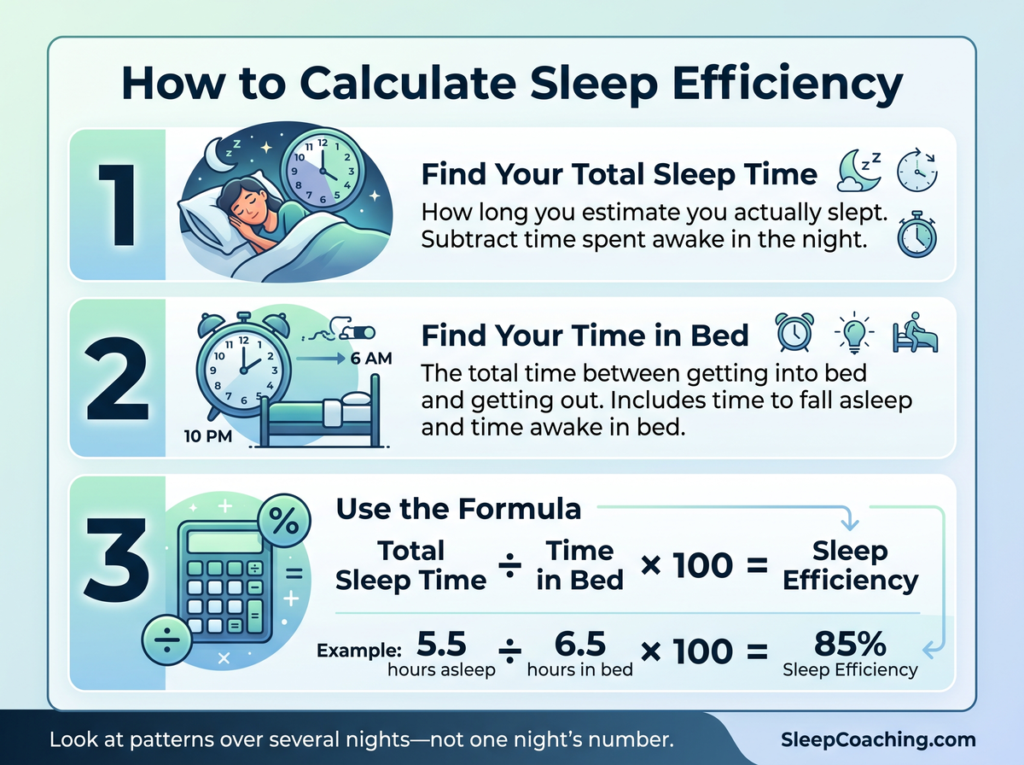
Sleep efficiency is one of the primary measurements used to evaluate how well your sleep period is working. It tells you what percentage of your time in bed was actually spent asleep.
The formula is:
Sleep efficiency = total sleep time ÷ time in bed × 100
For example, suppose you spent 6 hours and 30 minutes in bed but estimate that you slept for 5 hours and 30 minutes:
5.5 hours ÷ 6.5 hours × 100 = approximately 85% sleep efficiency
One night’s percentage isn’t particularly important by itself. Sleep naturally varies from night to night. Stress, travel, pain, noise, illness, and countless other factors can temporarily affect your sleep.
That’s why sleep restriction therapy typically looks at patterns over several nights rather than reacting to one difficult evening.
A weekly average may be used to guide the next adjustment:
| Weekly Sleep Efficiency | Common Example of Next Step |
|---|---|
| Below 85% | A clinician may shorten the scheduled sleep period slightly. |
| 85% to 89% | The sleep window often remains the same. |
| 90% or higher | The sleep period may be increased by 15 to 30 minutes. |
These thresholds are examples rather than universal instructions. Different CBT-I programs and clinicians may use different cutoffs or adjustment methods.
The principle is more important than any particular percentage: make small, deliberate changes based on a pattern of sleep rather than making large changes in response to one bad night.
A CBT-I clinical primer published in the National Library of Medicine provides more detail on how sleep efficiency can be used to guide gradual adjustments during treatment.
What the First Weeks Can Feel Like
The beginning of sleep restriction therapy can be challenging.
You may initially feel more tired because you’re no longer spending long stretches of time resting or trying to sleep in bed. Some temporary daytime sleepiness can occur as your schedule adjusts.
There is an important distinction, however, between expected tiredness and unsafe drowsiness.
If your alertness becomes impaired, don’t drive, operate machinery, or perform other activities in which falling asleep or losing concentration could put you or someone else in danger.
During the adjustment period, keep your schedule as consistent as you reasonably can. Get out of bed at your planned wake-up time and expose yourself to morning light by opening the curtains or going outside. Morning light helps reinforce your circadian rhythm.

Regular meals and daytime movement can also support a stable routine. Avoid naps unless your clinician has recommended them, because daytime sleep can reduce the sleep pressure you’re trying to build for nighttime.
After a poor night, resist the temptation to move bedtime substantially earlier. Doing so can recreate the extended time in bed that the treatment is intended to reduce.
If you’re lying awake and becoming increasingly frustrated, get out of bed and do something quiet in low light. Return when you feel sleepy again. This approach, known as stimulus control for insomnia, helps reinforce the connection between your bed and sleep. Avoid repeatedly checking the clock or switching to something stimulating.
If your sleep efficiency stops improving, look for small changes that may have crept into your routine. Weekend lie-ins, late caffeine, evening alcohol, unplanned naps, or inconsistent wake-up times can all interfere with the sleep drive and regularity the approach depends on.
Stress can play a role as well. You don’t need to eliminate every worry before going to bed. It may help to write down tomorrow’s tasks earlier in the evening and then transition to a calm, familiar activity before your scheduled bedtime.
People with unpredictable schedules may need a more individualized approach. Shift workers, caregivers, and people with rotating or on-call schedules may find a rigid self-directed plan impractical or unsafe. A CBT-I clinician can help identify an appropriate anchor time and adapt the treatment around real-world demands.
Safety Comes Before a Tighter Sleep Window
Sleep restriction therapy should never make your daily life unsafe.
If you experience excessive sleepiness or impaired alertness, do not drive, operate machinery, work at heights, or perform other hazardous tasks. Warning signs such as heavy eyelids, drifting attention, missed turns while driving, or brief lapses in awareness should be taken seriously.
Talk with a sleep specialist before trying sleep restriction therapy if you have suspected or untreated sleep apnea, a seizure disorder, bipolar disorder, serious depression, chronic pain that substantially disrupts sleep, or another complex medical condition that could affect sleep or alertness.
Professional supervision is also particularly important if you take medications that affect alertness or work in a safety-sensitive role, such as professional driving, operating heavy equipment, working overnight shifts, or making decisions where fatigue could put others at risk.
Symptoms including loud snoring, gasping during sleep, witnessed pauses in breathing, morning headaches, or severe daytime sleepiness also warrant medical evaluation. These may be signs of obstructive sleep apnea.
Sleep restriction therapy cannot diagnose or treat sleep apnea, and simply spending less time in bed does not address an underlying breathing disorder.
Persistent insomnia deserves attention as well. The Cleveland Clinic’s guide to CBT-I explains that limiting time in bed is temporary and that additional time is gradually added as sleep becomes more efficient.
Can You Use Sleep Restriction Therapy on Its Own?
Sleep restriction therapy can be used as a behavioral treatment for insomnia, but it is commonly delivered as one component of a broader CBT-I program.
That broader approach can be valuable because insomnia isn’t always just a scheduling problem. Racing thoughts, anxiety about bedtime, attempts to force sleep, and habits developed during months or years of poor sleep can all contribute to the cycle.
CBT-I provides additional strategies for addressing those factors while sleep restriction focuses more directly on consolidating sleep and reducing extended wakefulness in bed.
A qualified clinician can also review your sleep diary, identify a schedule that may be too aggressive, and determine when your sleep period should be adjusted. Guidance is particularly valuable if you take sleep medication, have a complex medical history, or find that your daytime functioning is getting worse rather than gradually improving.
Most importantly, don’t judge the process by a single night.
Sleep naturally fluctuates. One rough night doesn’t erase a week of progress, just as one great night doesn’t mean the process is complete. Your sleep diary helps you look at the larger pattern instead of allowing each morning to determine how you feel about your progress.
Frequently Asked Questions
Is sleep restriction therapy the same as sleep deprivation?
No. The purpose of sleep restriction therapy is to reduce unnecessary time awake in bed and strengthen the connection between bed and sleep—not to cause ongoing sleep deprivation. As sleep becomes more consolidated and efficient, the scheduled sleep period is gradually expanded.
How do I choose my starting sleep window?
Start with a one- to two-week sleep diary and calculate your average total sleep time. A qualified CBT-I clinician can use that information to help establish a conservative starting schedule, select a consistent wake-up time, and make sure the plan is appropriate for your circumstances.
How long does sleep restriction therapy take to work?
Improvement doesn’t happen on the same timeline for everyone. Sleep restriction therapy is generally adjusted gradually based on sleep patterns over time rather than judged after a night or two. The early adjustment period can be challenging, which is another reason consistency and appropriate guidance matter.
What should I do if I feel very tired during the first week?
Some temporary daytime tiredness can occur. However, don’t drive, operate machinery, work at heights, or perform other hazardous tasks if your alertness is impaired. Contact a healthcare professional if sleepiness becomes excessive or interferes with your ability to function safely.
Can I use sleep restriction therapy without CBT-I?
It can be used as a stand-alone behavioral treatment, but it is often easier to manage as part of CBT-I. A broader CBT-I program can also address bedtime anxiety, unhelpful thoughts about sleep, behavioral habits, and other factors that may contribute to insomnia.
What if I have loud snoring or breathing pauses during sleep?
Talk with a sleep specialist before trying sleep restriction therapy if you experience loud snoring, gasping, witnessed breathing pauses, morning headaches, or severe daytime sleepiness. These symptoms may indicate sleep apnea, which requires appropriate medical evaluation rather than simply limiting your time in bed.
A Steadier Relationship With Sleep
Sleep restriction therapy asks you to do something that can initially feel backward: spend less time trying to sleep in order to make the time you do spend in bed more effective.
The early adjustment isn’t always easy. But the objective isn’t to chase a perfect night or force your body to sleep on command. It’s to rebuild a more dependable pattern in which bedtime becomes associated with sleep rather than hours of wakefulness, frustration, and effort.
Keep safety at the center, work with a qualified clinician when appropriate, and judge progress by your patterns over time rather than by what happened last night.
Better sleep often grows from consistency, not from trying harder.

Stone Evans, Founder of SleepCoaching.com
Stone Evans is the founder of SleepCoaching.com which has become one of the most popular destinations online for people seeking better sleep. Stone started developing this website after realizing his own sleep struggles and then beginning an intensive period of study (which included professional sleep coach training) and ongoing lifestyle changes to improve and optimize his sleep.
Now through in-depth articles from sleep experts around the world, the internet's leading and most comprehensive sleep coaching directory, quantitative sleep product reviews and Stone's personal daily sleep tracking journey, visitors to our website regularly report gaining information and insights that are helping them achieve better health, better sleep and a better quality of life.

