

It’s 10:47 p.m. You’re tired. You know tomorrow’s alarm isn’t going to negotiate with you. And yet, instead of going to bed, you find yourself watching another episode, scrolling through your phone, or suddenly becoming deeply interested in a subject you couldn’t have cared less about six hours earlier.
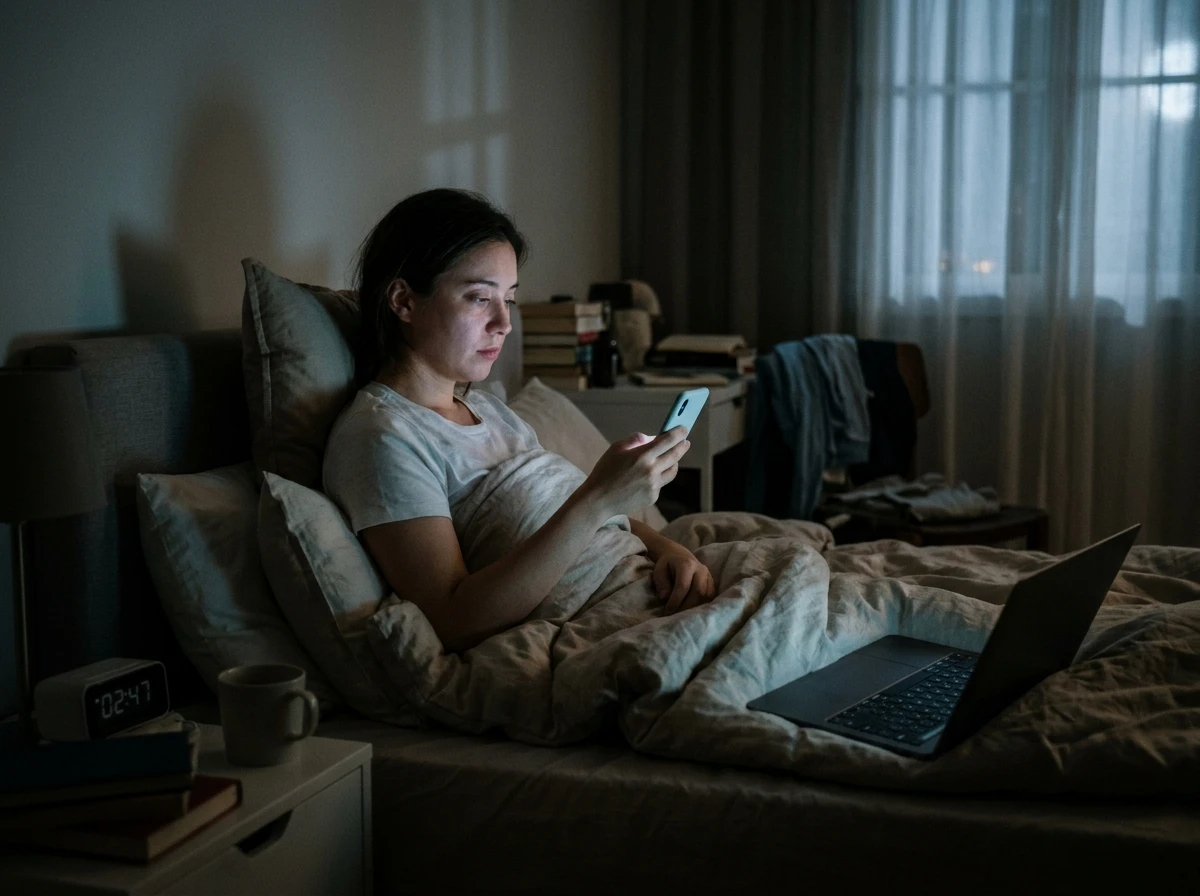
Maybe you’re researching the best coffee makers. Maybe you’re watching someone renovate a cabin in the wilderness. Maybe you’re doing absolutely nothing particularly enjoyable.
But you’re not going to bed.
The strange part is that you actually want more sleep. You’ve probably spent part of the day wishing you could take a nap. You’ve complained about being exhausted. You may have even promised yourself that tonight would be different.
So why, when the opportunity to sleep finally arrives, does your brain seem determined to stay awake?
The answer may have less to do with sleep than with something we don’t talk about nearly enough: the human need to feel that our time belongs to us.
There’s actually a name for this behavior: revenge bedtime procrastination. It’s the tendency to stay awake later than you intended, not because you have something important to finish, but because those late-night hours finally feel like your own.
When Bedtime Feels Like Giving Up Your Freedom
Think about how much of an ordinary day is already spoken for.
You wake up because an alarm tells you to. You work because responsibilities require it. You answer messages, meet deadlines, prepare meals, run errands, take care of family members, and handle the endless collection of small obligations that somehow consume an entire day.
Even when you enjoy your work and love the people you’re caring for, there’s a difference between doing something because you choose to and doing something because it’s expected of you.
Then evening arrives.
The emails stop. The house gets quiet. Nobody needs anything. For the first time all day, you can decide what happens next.
And what does your body want you to do?
Go unconscious for eight hours.
From a biological perspective, that’s a perfectly reasonable suggestion. From a psychological perspective, it can feel like a rather disappointing way to celebrate your newfound freedom.
This tension is at the heart of what researchers call bedtime procrastination.
The idea is straightforward: you delay going to bed even though nothing external is preventing you from doing so, and you expect that the delay will leave you worse off.
A related popular expression, revenge bedtime procrastination, describes something more specific. You stay awake late because the evening feels like your only opportunity to reclaim personal time.
The “revenge” isn’t directed at sleep itself. It’s directed, metaphorically, at a day that seemed to belong to everyone but you.
And that’s what makes the behavior so interesting.
You aren’t necessarily choosing entertainment over health.
You may be choosing autonomy over another obligation.
The Difference Between Being Tired and Being Ready to End the Day
One of the most revealing things about bedtime procrastination is that physical tiredness doesn’t automatically translate into a willingness to go to bed.
Sleepiness and motivation are related, but they aren’t the same thing.
Your body has biological systems that regulate sleep, including the gradual buildup of sleep pressure during wakefulness and the circadian rhythms that influence when you feel alert or sleepy.
But your behavior is also influenced by reward, emotion, habits, and the meaning you attach to an activity.
Imagine two evenings.
On the first, you’ve had a pleasant day. You enjoyed some personal time, accomplished what mattered, and spent the evening doing something you genuinely wanted to do. When bedtime arrives, it feels like a natural conclusion.
On the second, you’ve spent the entire day responding to other people’s demands. You barely had time to think. You finally sit down at 10 p.m., and suddenly the idea of going to bed feels almost offensive.
Your biological need for sleep might be similar on both nights.
Your psychological willingness to end the day may be completely different.
This helps explain why simply telling someone to “have more discipline” can miss the point.
Sometimes the issue isn’t a lack of knowledge about sleep.
It’s that bedtime has become associated with surrendering the only remaining hours that feel personally meaningful.
Why Your Phone Is So Good at Winning This Argument
Of course, the modern world has made bedtime procrastination remarkably convenient.
A generation ago, staying up late required finding something to do. Television programming eventually ended. Stores closed. Friends went home. The world offered at least a few natural stopping points.
Today, entertainment is effectively infinite.
There’s always another video, another article, another conversation, another recommendation, another interesting rabbit hole.
And the most dangerous feature of this arrangement isn’t necessarily how exciting the content is.
It’s how little effort is required to continue.
You don’t need to decide to spend another hour online. You only need to avoid deciding to stop.
That distinction matters.
When you’re mentally exhausted after a demanding day, making deliberate choices can feel harder. Continuing an activity that’s already underway is often easier than interrupting it, brushing your teeth, putting away your phone, and preparing for bed.
Digital platforms can make that continuation especially effortless through autoplay, personalized recommendations, and endlessly refreshed content.
It’s worth distinguishing two different influences here.
One is psychological: the desire to preserve personal time.
The other is behavioral: the ease of continuing an immediately rewarding activity.
Together, they can create a particularly stubborn bedtime habit.
And while screen light can influence circadian timing, especially when exposure is bright or prolonged, the problem isn’t always simply the light coming from your phone.
Sometimes it’s the fact that your phone keeps offering something more appealing than ending the evening.
The Research Behind Bedtime Procrastination
Bedtime procrastination isn’t just a catchy description of a familiar experience. It’s also a subject of scientific investigation.
In a 2014 study published in Frontiers in Psychology, researchers introduced bedtime procrastination as a distinct form of procrastination and examined its relationship with self-regulation.
They found that people who reported more bedtime procrastination also tended to report insufficient sleep and greater difficulty with self-regulation.
That doesn’t establish that poor self-control is the sole cause of the behavior. It does suggest that bedtime decisions involve more than simply knowing when we should sleep.
Later research has explored additional factors, including chronotype, emotional experiences, stress, and daily demands.
One particularly interesting question is whether people delay bedtime because they lack self-control or because they haven’t had enough satisfying personal time during the day.
Those explanations aren’t mutually exclusive.
A person might feel deprived of autonomy, seek a little evening enjoyment, and then find it difficult to disengage once an entertaining activity begins.
It’s also important to recognize that “revenge bedtime procrastination” is a popular description rather than a separate clinical diagnosis. The evidence for bedtime procrastination is more developed than the evidence for every psychological explanation attached to the revenge label.
Still, the concept points toward something useful.
If the problem begins with how your day feels, the solution may need to begin before bedtime.
The Hidden Cost of Borrowing Time From Tomorrow
There’s something almost financially irresponsible about bedtime procrastination.
You borrow an hour from tomorrow to make today feel better.
Except tomorrow charges interest.
You wake up tired, move more slowly, struggle to concentrate, and possibly find ordinary responsibilities more frustrating than they would otherwise feel.
Then, because the day feels exhausting or unsatisfying, you may be even more motivated to reclaim some personal time that evening.
And so the cycle repeats.
This isn’t inevitable, and not everyone who stays up late experiences it. But the possibility of a self-reinforcing pattern is worth recognizing.
Consider a hypothetical example.
Someone needs to wake at 6:30 a.m. and would ideally allow themselves eight hours in bed.
If they go to bed at 10:30 p.m., that provides an eight-hour sleep opportunity, although actual sleep time may be shorter.
But suppose they routinely delay bedtime until midnight because they want 90 minutes of uninterrupted personal freedom.
Their sleep opportunity shrinks to six and a half hours.
Over five work nights, that’s 7.5 hours less opportunity for sleep than their intended schedule.
That doesn’t mean they’ve accumulated a precisely measurable 7.5-hour biological sleep debt. Sleep need and actual sleep duration vary. But it illustrates how an apparently small nightly decision can meaningfully reduce the time available for rest.
And here’s the irony.
The extra evening time is supposed to improve quality of life.
Yet repeatedly sacrificing sleep may make the waking hours you’re trying to improve less enjoyable.
The Evening Freedom Experiment
What happens when your only personal time comes at the expense of sleep? Adjust the settings to explore a different approach.
How Your Night Could Change
What If You Protected Your Freedom Before Protecting Your Bedtime?
Most advice about bedtime procrastination focuses on what you should stop doing at night.
Put away your phone. Turn off the television. Set a bedtime alarm. Practice self-control.
Those strategies can be helpful, particularly when an absorbing activity is the main obstacle.
But they don’t necessarily address the emotional reason you wanted to stay awake in the first place.
A more interesting question might be:
What would have to change about your day for you to feel comfortable letting it end?
Maybe you need 30 minutes when nobody can ask you for anything.
Maybe you need time to read, exercise, take a walk, work on a personal project, or simply sit without being productive.
Maybe you’ve organized your schedule so efficiently that you’ve accidentally removed every moment of spontaneity.
Or perhaps your evenings have become the only place where you experience a genuine sense of choice.
If that’s the case, moving some personal freedom earlier in the day may be more effective than treating bedtime as another test of discipline.
Of course, not everyone has equal control over their schedule. Shift workers, parents of young children, caregivers, and people working multiple jobs may have very limited flexibility.
The point isn’t that everyone can magically create an extra hour.
It’s that even a modest amount of genuinely protected personal time may change how the evening feels.
And that brings us to a useful distinction.
Not All Free Time Feels Equally Free
Suppose you have an hour between finishing work and preparing dinner.
You spend it answering personal messages, checking social media, and doing a few small chores.
Technically, you weren’t working.
But did that hour feel like it belonged to you?
Maybe not.
There’s a difference between unstructured time and satisfying personal time.
One can disappear almost without being noticed. The other leaves you feeling that you’ve actually experienced something you chose.
This may explain why some people spend an entire evening scrolling and still feel as though they haven’t had any time for themselves.
The activity consumed the available hours without necessarily satisfying the need that motivated it.
It’s a little like opening the refrigerator repeatedly because you’re hungry, but never choosing anything that makes a meal.
You keep looking for satisfaction without quite arriving there.
So rather than asking only how much free time you have, consider asking how much of it feels intentional.
That small shift in perspective can be surprisingly revealing.
Try Giving Your Evening Two Different Jobs
One practical approach is to separate your evening into two distinct experiences.
The first is personal time.
This is when you deliberately do something because you want to. It might be entertaining, creative, relaxing, social, or wonderfully pointless.
The important thing is that it feels chosen.
The second is transition time.
This is when you gradually shift from the activities of the day toward sleep.
Instead of expecting yourself to move directly from a stimulating activity into bed, you create a small buffer.
For example, imagine someone who usually gets home at 7 p.m. and wants to be in bed by 10:30.
Rather than letting the entire evening become an undefined mixture of chores, entertainment, and distractions, they might deliberately protect 30 minutes for something personally enjoyable.
Later, they establish a reasonably consistent point at which stimulating activities wind down.
This doesn’t require a complicated ritual or an elaborate nighttime routine.
It simply means that personal enjoyment and preparation for sleep are no longer competing for exactly the same final moments of the day.
The key is flexibility.
If the schedule becomes another rigid obligation, it may recreate the very feeling of lost autonomy that contributed to the problem.
A Small Experiment: Find Out What You’re Actually Staying Awake For
Before changing anything, try observing your evenings for a few days.
Not with the goal of judging yourself or achieving a perfect bedtime, but with genuine curiosity.
When you find yourself staying awake later than intended, ask three questions:
1. What am I doing right now?
Be specific. Watching videos, reading, chatting, working, worrying, or simply avoiding the transition to bed?
2. What am I getting from this activity?
Entertainment? Relaxation? Connection? A sense of accomplishment? Relief from responsibility? The feeling that nobody is controlling my time?
3. If I had experienced more of that feeling earlier today, would I still want to stay awake?
You might discover that the issue is primarily habit.
You might discover that you need better boundaries around work.
You might realize that you rarely make room for activities that are personally meaningful.
Or you might find that you’re genuinely not sleepy at your intended bedtime, which could point toward a scheduling or circadian timing issue rather than bedtime procrastination.
The goal is to understand the behavior before trying to eliminate it.
Because two people who stay awake until midnight may be doing so for completely different reasons.
And the same solution won’t necessarily help both.
When Staying Up Late Isn’t Really Procrastination
There’s an important distinction between choosing to delay bedtime and being unable to sleep when you try.
Someone experiencing insomnia may go to bed at a reasonable hour and remain awake despite wanting to sleep.
Someone with a delayed sleep-wake phase may naturally become sleepy much later than their social or work schedule allows.
Others may struggle because of anxiety, pain, medication effects, irregular work hours, or other factors.
These experiences can overlap with bedtime procrastination, but they aren’t interchangeable.
If you consistently struggle to fall asleep, experience substantial daytime sleepiness, or find that sleep problems are affecting your daily life, it’s worth discussing the pattern with a qualified healthcare professional.
Simply forcing an earlier bedtime isn’t always the answer, particularly when your biological timing doesn’t support it.
Understanding why you’re awake matters more than attaching a convenient label to the behavior.
You Don’t Have to Choose Between Living and Sleeping
Perhaps the most unfortunate thing about revenge bedtime procrastination is the false choice it creates.
Either you enjoy your life tonight, or you get enough sleep to function tomorrow.
But personal freedom and restorative sleep aren’t opposing needs.
They’re both part of a satisfying life.
The challenge is that one provides an immediate reward, while the benefits of the other are often easier to appreciate the following day.
An extra episode feels good right now.
A well-rested morning is a reward you haven’t experienced yet.
That imbalance can make bedtime decisions surprisingly difficult, especially after a demanding day.
But there’s another way to look at it.
Sleep isn’t the moment when your freedom ends.
It’s part of what helps make your waking freedom worth having.
It supports the attention you bring to conversations, the patience you have with people, the energy you invest in your interests, and the ability to enjoy the experiences you’ve worked so hard to make time for.
So the next time you find yourself resisting bedtime, don’t immediately assume you need more willpower.
Ask whether you’ve had enough opportunity to be yourself today.
Because sometimes the answer to staying up too late isn’t learning to love sleep more.
It’s finding a way to enjoy your waking life before the clock runs out.

Stone Evans, Founder of SleepCoaching.com
Stone Evans is the founder of SleepCoaching.com which has become one of the most popular destinations online for people seeking better sleep. Stone started developing this website after realizing his own sleep struggles and then beginning an intensive period of study (which included professional sleep coach training) and ongoing lifestyle changes to improve and optimize his sleep.
Now through in-depth articles from sleep experts around the world, the internet's leading and most comprehensive sleep coaching directory, quantitative sleep product reviews and Stone's personal daily sleep tracking journey, visitors to our website regularly report gaining information and insights that are helping them achieve better health, better sleep and a better quality of life.

