

You can follow standard sleep advice—keep a consistent bedtime, avoid late-night scrolling, create a relaxing routine—and still feel like your schedule is working against you. Your chronotype may be one reason.
Some people naturally become sleepy earlier and feel sharp soon after waking. Others hit their stride later and struggle to feel sleepy when they’re supposedly “meant” to go to bed.
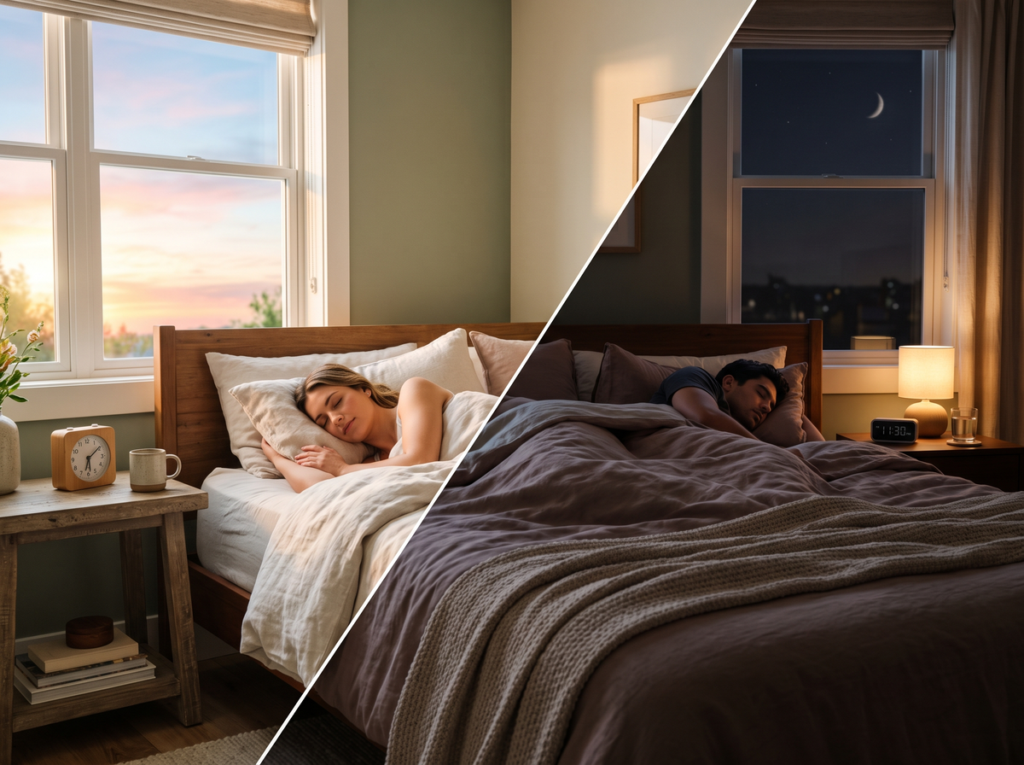
Neither pattern is automatically better.
Your chronotype reflects your body’s natural preference for when to sleep, wake, and be active. Understanding it won’t eliminate the realities of work, school, children, or other responsibilities. But it can help you build a sleep routine that works with your internal clock instead of constantly pushing against it.
This guide will help you understand your chronotype, identify your natural sleep window, and make practical adjustments—even when life doesn’t perfectly cooperate.
Key Takeaways
- Chronotype describes your natural tendency toward earlier or later sleep and activity. It exists on a spectrum rather than fitting perfectly into a few rigid categories.
- Your chronotype is influenced by biology, but it isn’t completely fixed. Genetics play a role, while age, light exposure, routines, and environmental demands can also influence sleep timing.
- The best chronotype sleep routine starts with your natural tendencies, not an arbitrary bedtime.
- Consistency matters. Large differences between workday and free-day schedules can create “social jetlag.”
- You don’t need to redesign your entire life around your chronotype. Even small adjustments to sleep timing, light exposure, and daily routines can create better alignment.
Table of Contents
What Is a Chronotype?
A chronotype is your individual tendency to sleep, wake, and feel most alert at particular times of day.
You may already recognize yours without knowing the term.
If you naturally wake early, feel mentally sharp in the morning, and become sleepy relatively early at night, you probably lean toward morningness. If getting up early feels unnatural but your energy and concentration improve later in the day, you may lean toward eveningness.
Researchers generally describe these differences along a morningness-eveningness spectrum, with many people falling somewhere between the two extremes.
Chronotype is related to your circadian rhythm, but the terms aren’t interchangeable.
Your circadian rhythm is the approximately 24-hour biological timing system that helps coordinate sleep and wakefulness along with many other processes throughout the body. Light and darkness are particularly powerful signals for this system, although food intake, physical activity, social environment, stress, and temperature can also influence circadian rhythms.
Your chronotype describes how the timing of that system tends to express itself in you—whether you naturally lean earlier, later, or somewhere in between.
Put simply:
Your circadian rhythm is your body’s daily clock. Your chronotype helps describe where your preferred schedule falls on that clock.
Are You a Lion, Bear, Wolf, or Dolphin?
You’ve probably seen chronotypes described using four animals:
- Lion: generally associated with an earlier sleep-wake preference
- Bear: generally associated with a more middle-of-the-road schedule
- Wolf: generally associated with a later sleep-wake preference
- Dolphin: often used to describe lighter, more irregular, or easily disrupted sleepers
This framework can be a useful and memorable way to think about your tendencies, but there is an important distinction.
Scientific chronotype research generally does not divide everyone into four animal categories. Researchers more commonly measure morningness and eveningness using validated questionnaires, reported sleep timing, activity data, or biological circadian markers.
So think of Lion, Bear, Wolf, and Dolphin as a practical interpretation tool, not four rigid biological boxes.
With that distinction in mind, here’s a quick look at the general sleep and energy patterns commonly associated with each of the four popular chronotype types.
The Four Chronotypes at a Glance
Sleep windows, peak energy, and common challenges for each type
Naturally wakes early, hits peak productivity before most people start their day, and winds down early in the evening.
Follows the sun — wakes with morning light, steady energy through midday, and naturally sleepy as evening arrives.
Struggles with early mornings, but comes alive in the evening — sharpest and most energetic after most people wind down.
Sleep is light and easily disrupted, with energy that’s harder to predict and more sensitive to stress or environment.
These are general tendencies, not prescribed sleep schedules. Your individual sleep timing, sleep needs, and energy patterns may differ.
If you’re curious where you fit, you can take the free two-minute Sleep Chronotype Test at SleepChronotype.net. It provides a Lion, Bear, Wolf, or Dolphin result along with guidance for your sleep schedule and daily energy patterns.
Then come back here, because knowing your chronotype is only the beginning.
The more useful question is:
What should you actually do with that information?
Why Your Chronotype Matters for Sleep
Imagine two people trying to follow the same 10:30 p.m. bedtime.
The first naturally becomes sleepy around 10:00. The second rarely feels genuinely sleepy until after midnight.
The clock says the bedtime is identical.
Their biology may say something very different.
For the first person, 10:30 may feel effortless. For the second, getting into bed at 10:30 could mean lying awake trying to force sleep before the body is ready for it.
This is one reason “go to bed earlier” isn’t always useful sleep advice.
Sleep timing is influenced by an interaction between your circadian system and homeostatic sleep pressure—the pressure for sleep that generally builds the longer you are awake.
Good sleep depends on more than simply spending enough hours in bed. Ideally, your opportunity for sleep occurs at a time when sufficient sleep pressure and your circadian biology are both supporting it.
Your chronotype gives you a clue about when that window naturally occurs.
The Chronotype Sleep Routine: Start With Your Natural Sleep Window
Instead of asking:
“What is the perfect bedtime?”
Start with:
“When does my body naturally want to sleep?”
You can learn a surprising amount by observing yourself during periods when alarms and obligations aren’t dictating your schedule.
For one or two weeks, pay attention to:
- When you first begin feeling genuinely sleepy
- When you fall asleep without trying to force it
- When you wake naturally without an alarm
- When you feel most alert
- When your energy tends to dip
- How different your schedule becomes on weekends or days off
Don’t base your chronotype on one late Saturday morning after an exhausting week. Look for a pattern.
A sleep diary can make that pattern much easier to see.
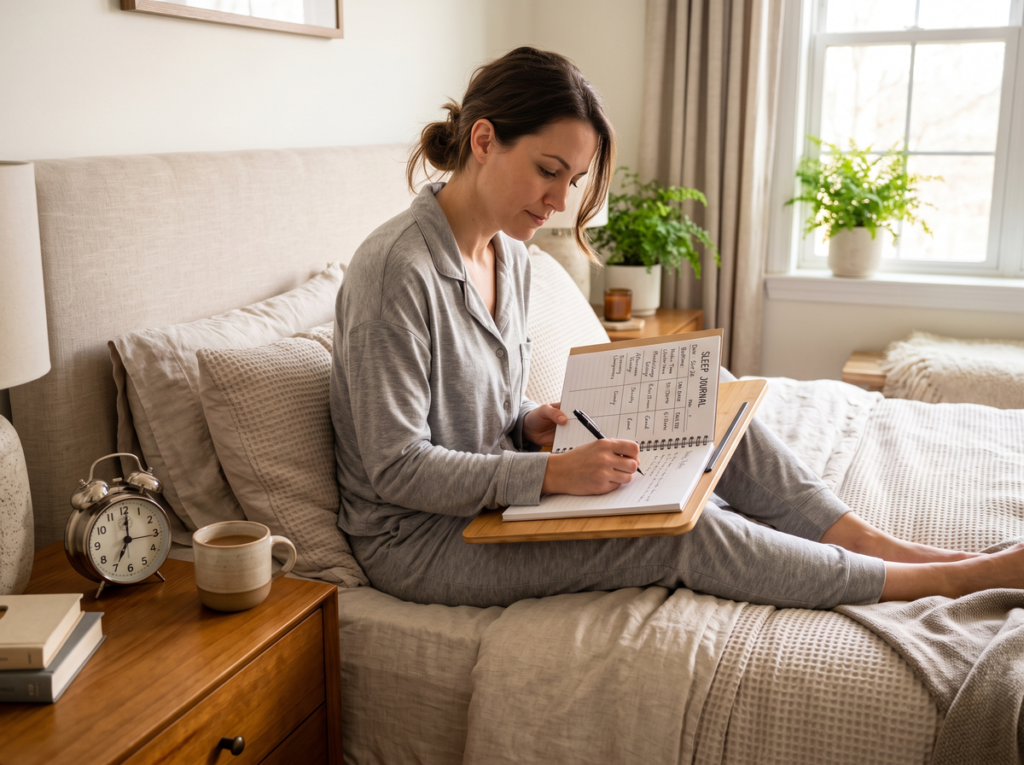
Once you recognize your natural window, you can begin constructing your routine around it.
A Practical Chronotype Sleep Routine
Your exact clock times will be individual, but the sequence below provides a useful framework.
| Part of Day | Morning-Leaning Chronotype | Intermediate Chronotype | Evening-Leaning Chronotype |
|---|---|---|---|
| Wake | Naturally earlier | Middle range | Naturally later |
| First hours awake | Often alert relatively quickly | Energy builds normally | May need more time to feel fully alert |
| Best focus window | Often earlier in the day | Often late morning to afternoon | Often later in the day |
| Energy decline | May begin earlier | Usually moderate | Often occurs later |
| Wind-down | Begin earlier | Middle range | Begin later when possible |
| Natural sleep window | Earlier | Intermediate | Later |
| Biggest challenge | Late-night social demands | Maintaining consistency | Early work/school demands |
Important: This table is a framework, not a prescription. Your sleep need still matters. A late chronotype who must wake at 6:00 a.m. cannot simply choose a 1:00 a.m. bedtime without creating sleep deprivation.
For adults, regularly getting enough sleep remains more important than perfectly expressing a preferred chronotype.
That creates the central rule of a chronotype-based routine:
Work with your natural timing where you can, protect adequate sleep where you can’t, and aim for consistency between the two.
Step 1: Anchor Your Wake Time
If you want a more stable sleep routine, wake time is one of the most useful places to begin.
Choose a wake time that:
- Works with your real-world obligations.
- Allows enough opportunity for sleep.
- Is reasonably close to your natural preference.
- Can remain fairly consistent from day to day.
This doesn’t mean you must wake at exactly 6:47 every morning for the rest of your life.
It means avoiding dramatic swings whenever possible.
If you wake at 6:30 a.m. Monday through Friday but routinely sleep until 10:30 on weekends, your body is receiving very different timing signals across the week.
That brings us to one of the most important chronotype concepts.
Step 2: Reduce Social Jetlag
Social jetlag describes the mismatch that can occur between your biological timing and the schedule imposed by work, school, or social obligations.
It can resemble traveling across time zones without actually going anywhere.
A later chronotype might stay up until 1:00 a.m. and wake at 9:00 a.m. when free to choose—but be forced to wake at 6:30 during the workweek.
By Friday, sleep debt has accumulated.
Then comes Saturday morning and a long sleep-in.
Sunday night arrives, the person isn’t sleepy at the desired hour, and Monday morning feels like jetlag all over again.
Research on chronotype and social jetlag highlights how late chronotypes can be particularly vulnerable when early social schedules conflict with their biological timing.
You may not be able to change when work begins.
But you can often reduce the size of the weekly shift.
Maintaining a consistent sleep schedule can help. Try keeping weekend wake times closer to your weekday schedule rather than switching between two dramatically different sleep patterns.
Step 3: Use Light as a Timing Signal
If there is one environmental factor your circadian system pays close attention to, it’s light.
Light and darkness are major signals used by the body to coordinate circadian timing.
For someone trying to maintain a conventional daytime schedule, getting daylight after waking and reducing unnecessarily bright light toward bedtime can help reinforce the distinction between biological day and night.
This becomes especially relevant for evening chronotypes who need to operate on an earlier schedule than they naturally prefer.
But timing matters. Light isn’t simply “good in the morning and bad at night” in every circumstance; its circadian effects depend on when it occurs relative to your internal biological clock.
That is particularly important if you have an extreme delayed or advanced sleep schedule. In those situations, precisely timed bright-light therapy is better treated as an intervention to discuss with a qualified clinician rather than something to improvise.
Step 4: Let Sleepiness Help Set Bedtime
A consistent routine doesn’t mean climbing into bed simply because the clock says you should.
Look for genuine signs of sleepiness:
- Heavy eyelids
- Repeated yawning
- Difficulty maintaining attention
- A strong desire to close your eyes
- Feeling as though staying awake requires effort
That’s different from being tired.
You can be mentally exhausted, stressed, bored, or physically worn out without being biologically ready to sleep.
If you’re repeatedly getting into bed long before you feel sleepy and then spending substantial time awake, your target bedtime may deserve another look.
This idea overlaps with stimulus control for insomnia, a core CBT-I technique designed to strengthen the association between bed and sleep rather than spending long periods awake in bed.
Step 5: Build Your Wind-Down Backward From Your Sleep Window
Once you’ve identified a realistic sleep window, work backward.
If your natural sleepiness tends to emerge around 11:00 p.m., for example, you might begin transitioning toward sleep around 10:00 rather than declaring that 9:30 is your new bedtime.
Your wind-down doesn’t need to be elaborate. A consistent bedtime routine can help create predictable cues that the active part of the day is ending.
The goal is to gradually reduce stimulation and help your mind and body transition toward sleep.
That could include:
- Dimming the environment
- Finishing work
- Putting away highly stimulating content
- Taking a shower
- Reading
- Gentle stretching
- Preparing the bedroom
- Following the same few steps each night
The routine should support sleepiness—not become another performance you have to execute perfectly.
Step 6: Put Your Best Hours to Work
Chronotype isn’t only about bedtime.
It can also help explain why the same task feels easy at one hour and painfully difficult at another.
Research has found evidence of a synchrony effect, in which performance can differ depending on whether a task occurs at a more optimal or suboptimal time for someone’s chronotype.
When your schedule allows, experiment with matching your most demanding activities to periods when you naturally feel more alert.
For example:
Morning-leaning:
Consider protecting earlier hours for deep work, problem solving, exercise, or demanding decisions.
Intermediate:
You may have greater flexibility, with productive periods spanning conventional daytime hours.
Evening-leaning:
When possible, avoid assuming your first waking hour must be your highest-performance hour. Important creative or cognitive work may fit better later.
This isn’t permission to reorganize every responsibility around a chronotype label.
It’s simply another piece of information you can use when deciding when to do things.
What If Your Chronotype Doesn’t Fit Your Life?
This is where chronotype advice has to become realistic.
It’s easy to tell a night owl to “honor your natural rhythm.”
It’s much harder when the alarm goes off at 6:00 a.m.
Most people don’t have complete control over their schedules. Work, school, commuting, caregiving, relationships, and family responsibilities all create fixed points in the day.
So if your preferred schedule and required schedule don’t match, don’t aim for perfect alignment.
Aim for the best workable compromise.
Protect Sleep Duration First
If you have to wake early, a naturally late bedtime shouldn’t become an excuse to chronically sleep five hours.
In 2024, 30.5% of U.S. adults reported averaging less than seven hours of sleep per 24-hour period.
Shift Gradually When Necessary
If you need to move your schedule earlier, don’t expect your body to instantly cooperate with a bedtime two hours earlier than usual.
Small, consistent adjustments are generally more realistic than abruptly forcing a dramatically different schedule.
Strengthen Your Daytime Signals
A consistent wake time, appropriate daytime light exposure, physical activity, and regular daily routines can all provide timing information to your circadian system.
Reduce the Weekend Rebound
Sleeping dramatically later every weekend may feel necessary after a sleep-deprived week, but it can also perpetuate the difference between your weekday and weekend clocks.
The better long-term target is usually reducing the sleep debt that makes the rebound necessary in the first place.
Can You Change Your Chronotype?
To an extent—but “change” needs some context.
Chronotype has a meaningful biological and genetic component. Large genetic studies have identified hundreds of genetic variants associated with morningness, reinforcing that being an early bird or night owl isn’t simply a matter of discipline.
At the same time, your observed sleep timing isn’t determined by genes alone.
Light exposure, daily routines, social schedules, behavior, and age all interact with your circadian system.
Chronotype also changes naturally across the lifespan.
Children tend to skew earlier. During adolescence, people typically shift toward greater eveningness, followed by a gradual movement back toward morningness through adulthood.
So yes, your sleep schedule can shift.
But trying to transform a strongly evening-oriented person into someone who loves waking at 5:00 a.m. may be neither necessary nor realistic.
A better goal is often circadian alignment, not chronotype conversion.
Don’t Confuse an Evening Chronotype With a Sleep Disorder
Preferring a later bedtime doesn’t automatically mean something is wrong.
An evening-oriented person may sleep perfectly well when allowed to follow a later schedule.
That’s different from a circadian rhythm sleep-wake disorder.
For example, delayed sleep-wake phase disorder involves sleep and wake timing that is substantially delayed relative to required or desired times and creates meaningful difficulty functioning within necessary schedules.
Similarly, consistently struggling to sleep isn’t automatically evidence of the wrong chronotype.
Insomnia, sleep apnea, restless legs syndrome, medication effects, mental health conditions, environmental disruptions, and many other factors can interfere with sleep regardless of chronotype.
If your sleep timing is extreme, you consistently cannot fall asleep or wake when required, or sleep problems are significantly interfering with daytime life, chronotype self-help may not be enough.
A sleep physician or other qualified healthcare professional can help determine whether you’re dealing with a preference, a circadian rhythm disorder, insomnia, or another sleep problem.
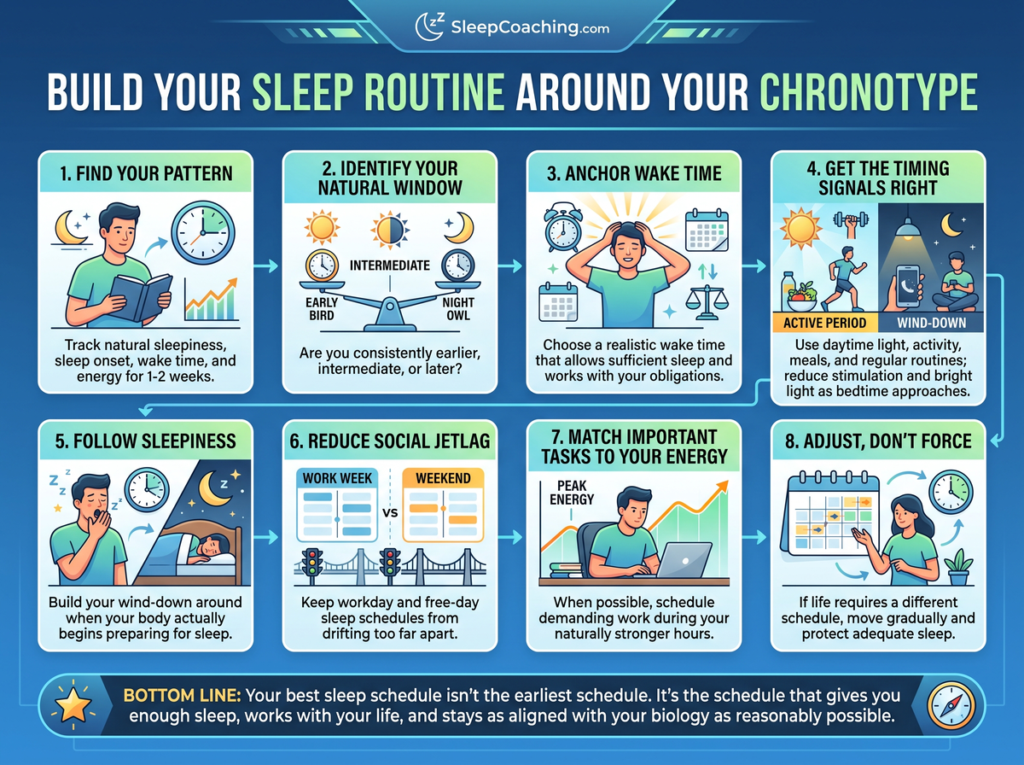
Your Chronotype Sleep Routine at a Glance
Use this eight-step guide to turn what you’ve learned about your chronotype into a practical sleep routine. The goal isn’t to follow a rigid schedule, but to better align your sleep timing with your natural patterns while still getting enough sleep and meeting the demands of everyday life.
A 7-Day Chronotype Experiment
You don’t have to overhaul your sleep schedule tonight.
Instead, spend the next seven days collecting information.
Days 1–3: Observe
Keep your current routine, but record:
- Bedtime
- Approximate sleep time
- Wake time
- Whether an alarm woke you
- Morning energy
- Time of strongest focus
- Afternoon energy
- When genuine sleepiness begins
Days 4–5: Look for the pattern
Ask:
- Am I repeatedly trying to sleep before I’m sleepy?
- Do I wake naturally much later when given the chance?
- Does my energy peak earlier or later than my schedule assumes?
- How different are my workday and free-day sleep times?
Days 6–7: Make one adjustment
Don’t change everything.
Choose the most obvious mismatch.
Maybe it’s getting outside after waking. Maybe it’s moving your wind-down 30 minutes later because you’ve been forcing an unrealistic bedtime. Maybe it’s keeping Sunday morning closer to your weekday wake time.
Then observe what happens.
Sleep improvement often works better as an experiment than a command.
Frequently Asked Questions
What is the best sleep schedule for my chronotype?
There isn’t one universal clock-time schedule for each chronotype. Your best schedule should account for your natural sleepiness and wake tendencies, the amount of sleep you need, and real-world obligations. Morning-oriented people generally function better on earlier schedules, while evening-oriented people tend to prefer later ones, but individual timing varies considerably.
How do I know what my chronotype is?
Observe when you naturally become sleepy, wake without an alarm, and feel most alert—particularly when work and social demands aren’t dictating your schedule. Formal chronotype questionnaires can provide additional information. If you’d like a simple starting point, the Sleep Chronotype Test provides a free two-minute Lion, Bear, Wolf, or Dolphin assessment.
Is it healthier to be a morning person?
Not automatically. Earlier chronotypes often fit more easily into conventional work and school schedules, which can make consistency and adequate sleep easier. The larger issue is often whether your biological timing and required schedule are aligned—not whether your chronotype has an early or late label.
Can a night owl become a morning person?
Sleep timing can shift, and environmental signals such as light exposure and consistent routines can influence circadian timing. But chronotype also has biological and genetic influences. Rather than trying to completely change who you are, it may be more practical to move your schedule enough to meet your needs while protecting adequate sleep.
Does chronotype change with age?
Yes. Chronotype typically shifts later during adolescence and then gradually moves earlier through adulthood. This is one reason teenagers often naturally struggle with very early schedules.
What is social jetlag?
Social jetlag is a mismatch between your internal biological timing and externally required schedules. A common example is waking early for work throughout the week but sleeping and waking several hours later on weekends.
Should I go to bed at the same time every night?
Consistency is helpful, but bedtime doesn’t need to be exact to the minute. A reasonably stable schedule combined with attention to genuine sleepiness is often more practical than forcing yourself into bed at an exact hour when you aren’t sleepy.
What if I can’t sleep during my supposed chronotype bedtime?
Don’t assume a chronotype chart overrides what your body is telling you. Animal chronotype schedules and online recommendations are generalizations. If you’re repeatedly unable to sleep at the suggested time, your individual sleep timing may differ—or another sleep issue may be involved.
Your Chronotype Is a Guide, Not a Rule
Learning your chronotype can feel like finally finding an explanation for something you’ve noticed for years.
“So that’s why mornings have always been difficult.”
Or:
“That explains why I’m ready to start the day before everyone else.”
That recognition can be useful.
But don’t replace one rigid sleep rule with another.
You don’t need to eat breakfast at 7:30 because you’re a Lion, schedule your best ideas for 9:00 p.m. because you’re a Wolf, or assume every difficult night can be explained by your chronotype.
Use chronotype as information.
Notice your body’s patterns. Protect enough sleep. Keep your schedule reasonably consistent. Use light and daily routines intelligently. Adjust your environment where you can, and make sensible compromises where you can’t.
The goal isn’t to live according to a chronotype chart.
It’s to understand your biological timing well enough to build a life—and a sleep routine—that stops fighting it.
The best sleep schedule isn’t the one that looks ideal on the clock. It’s the one your biology and your real life can sustain together.

Stone Evans, Founder of SleepCoaching.com
Stone Evans is the founder of SleepCoaching.com which has become one of the most popular destinations online for people seeking better sleep. Stone started developing this website after realizing his own sleep struggles and then beginning an intensive period of study (which included professional sleep coach training) and ongoing lifestyle changes to improve and optimize his sleep.
Now through in-depth articles from sleep experts around the world, the internet's leading and most comprehensive sleep coaching directory, quantitative sleep product reviews and Stone's personal daily sleep tracking journey, visitors to our website regularly report gaining information and insights that are helping them achieve better health, better sleep and a better quality of life.

