

Sharing a bed is supposed to be one of the comforting parts of a relationship.
Until one person snores. Or steals the blankets. Or tosses and turns. Or needs the room at 65 degrees while the other is shivering under three layers.
Maybe one partner goes to bed at 9:30 while the other is still answering emails at midnight. Maybe someone wakes at the slightest movement. Maybe an alarm rings at 5:00 a.m. for one person while the other doesn’t need to get up for another two hours.
Eventually, sharing a bed can start feeling less romantic and more like a nightly negotiation.
Despite the dramatic name, a sleep divorce doesn’t mean ending a relationship. It simply means partners intentionally sleep in separate beds or rooms to improve their sleep.
That’s where the idea of a sleep divorce comes in.
And more couples appear willing to consider it.
Not sure whether sleeping apart makes sense for you? Take our 2-minute Sleep Divorce Quiz to get personalized guidance based on your situation.
Emerging research and recent surveys suggest that separate sleeping arrangements are far from unusual. But that doesn’t mean everyone should start converting the guest room into a second primary bedroom.
Sleeping apart can solve some sleep problems. It can also create new relationship challenges if one partner feels rejected, lonely, or disconnected.
The real question isn’t whether couples are supposed to sleep together.
It’s whether your current sleeping arrangement is helping both of you get the rest—and connection—you need.
The best sleeping arrangement isn’t necessarily the one that looks most traditional. It’s the one that allows both partners to sleep well and still feel like partners.
Key Takeaways
- A sleep divorce means partners intentionally sleep separately to improve sleep; it does not necessarily indicate relationship trouble.
- Snoring, movement, different schedules, temperature preferences, insomnia, pets, and conflicting sleep habits are common reasons couples consider sleeping apart.
- Separate sleeping may improve sleep when one partner repeatedly disrupts the other’s rest.
- Sharing a bed can also provide emotional closeness, intimacy, comfort, and potentially beneficial sleep synchronization, so sleeping separately isn’t automatically better.
- A sleep divorce should ideally be a mutual decision, not something one partner simply imposes while the other feels abandoned.
- Couples don’t necessarily need separate bedrooms. Separate blankets, a larger bed, different bedtimes, occasional separate sleeping, or separate beds in the same room may solve the problem.
- Loud snoring, gasping, choking, or pauses in breathing shouldn’t simply be escaped by moving rooms because they can be signs of obstructive sleep apnea.
- The goal isn’t to win an argument about where couples should sleep. It’s to create a sleep arrangement that protects both rest and connection.
Table of Contents
What Is a Sleep Divorce?
A sleep divorce is an informal term for an arrangement in which romantic partners choose to sleep separately rather than routinely sharing the same bed.
That might mean separate bedrooms.
But it doesn’t have to.
Some couples sleep in separate beds in the same room. Others share a bed most nights but sleep separately when one partner is sick, has an unusually early schedule, is experiencing insomnia, or simply needs uninterrupted rest.
Some couples even start the night together and move to separate sleep spaces when they’re ready to actually sleep.
So the word divorce is arguably misleading.
A healthier way to think about it may be as an intentional sleep arrangement.
You’re not necessarily separating from your partner.
You’re separating two sleep environments that aren’t working well together.
And that distinction matters.
Sleep Divorce Is More Common Than You Might Think
Sleeping separately can still carry cultural baggage.
For many couples, sharing a bed symbolizes intimacy, security, and a healthy relationship. Separate bedrooms can therefore look—from the outside—like something must be wrong.
But the practice appears to be much more common than that stereotype suggests.
Recent survey data from the American Academy of Sleep Medicine found that 31% of U.S. adults had slept in another bed in the same bedroom or another space to accommodate a bed partner.
And researchers are beginning to study the phenomenon more directly.
A 2026 analysis from the ELSA-Brasil study examined sleep divorce among adults with partners, reflecting growing scientific interest in why couples choose separate sleeping arrangements and what factors may be associated with that choice.
The important takeaway isn’t that sleeping separately is becoming the new ideal.
It’s that there is no single sleeping arrangement that works for every couple.
Why Couples Consider Sleeping Apart
Most sleep divorces aren’t really about the relationship.
They’re about what happens after the lights go out.
Snoring
One partner may fall asleep peacefully while the other spends the night listening to what sounds like a chainsaw operating six inches away.
Snoring can cause repeated awakenings, difficulty falling back asleep, frustration, and resentment.
But there is an important health consideration here that we’ll return to later: loud or disruptive snoring can sometimes indicate obstructive sleep apnea.
Tossing, Turning, and Movement
Some people barely move all night.
Others seem to perform an entire gymnastics routine while sleeping.
Frequent movement, restless legs, kicking, blanket pulling, or simply getting in and out of bed can repeatedly disturb a lighter sleeper.
Different Sleep Schedules
One partner may naturally become sleepy at 9:30 p.m.
The other may feel wide awake until midnight.
Then one alarm rings at 5:00 a.m. while the other planned to sleep until 7:30.
Neither schedule is necessarily wrong.
But combining them in one bedroom can mean both people compromise their sleep.
Different Temperature Preferences
Temperature is surprisingly personal.
One person wants a cool bedroom, a fan, and lightweight bedding.
The other wants flannel pajamas and another blanket.
When both people are trying to control the same sleep environment, someone often loses.
Insomnia or Light Sleeping
A person experiencing insomnia may become highly sensitive to sound, movement, light, or even the anticipation that their partner might disturb them.
Meanwhile, the partner may start trying not to move, cough, get up, or make noise.
Now both people are thinking about sleep.
That’s rarely helpful.
Different Wind-Down Habits
One person wants complete darkness and silence.
The other wants to read.
Or watch television.
Or listen to a podcast.
Or scroll through their phone.
Even relatively harmless bedtime preferences can become incompatible when two people need different conditions to transition into sleep.
Pets and Children
Sometimes the problem isn’t either partner.
It’s the dog stretched horizontally across half the mattress.
Or the toddler who appears at 2:17 a.m.
Or the baby waking throughout the night.
Life circumstances can temporarily make separate sleeping a practical way to protect at least some sleep for both partners.
Can a Sleep Divorce Actually Improve Sleep?
Potentially, yes.
If another person’s snoring, movement, schedule, alarms, temperature preferences, or nighttime habits are repeatedly waking you, removing that disturbance may improve your opportunity for uninterrupted sleep.
That’s not particularly mysterious.
If the environment is disrupting sleep, changing the environment can help.
But research on couples and sleep also tells us something important:
Sleeping alone isn’t automatically better.
A 2025 review examining co-sleeping, sleep quality, and relationship health describes a complicated relationship between shared sleep and well-being. Bed sharing can promote emotional intimacy and synchronization, but it can also worsen sleep disturbances when one partner has insomnia, obstructive sleep apnea, or other sleep problems.
Another sleep-laboratory study of bed-sharing produced an especially interesting finding.
Researchers studying healthy young couples found that sleeping together was associated with about 10% more REM sleep, less fragmented REM sleep, and greater synchronization of sleep stages—even though participants also moved their limbs more while sharing the bed.
In other words:
Your partner can be both a source of sleep disruption and a source of sleep-related comfort.
That’s why the decision isn’t as simple as asking:
Do I sleep more quietly alone?
A better question is:
Which arrangement leaves both of us sleeping well and feeling good about our relationship?
Can Sleeping Apart Improve Your Relationship?
For some couples, it may.
Imagine being awakened by your partner’s snoring six times every night.
At 2:00 a.m., you nudge them.
At 3:00, you ask them to roll over.
At 4:00, you’re lying awake listening for the next snore.
By breakfast, you’re exhausted—and somehow angry at a person who was unconscious for most of the offense.
Repeat that for months and sleep disruption can become relationship friction.
Research examining couples’ sleep and relationship conflict has found associations between sleep-related behaviors, sleep quality, emotional distress, and relationship conflict.
In that sense, separate sleeping can sometimes remove a recurring source of resentment.
Better-rested partners may have more patience, emotional regulation, energy, and capacity to communicate.
But there’s another side.

Sharing a bed creates moments that aren’t really about sleep.
Talking in the dark.
Cuddling.
Touching.
Sex.
Laughing about something before falling asleep.
Reaching for each other during the night.
Waking up together.
Those small rituals can matter.
If separate sleeping removes them without replacing them with other forms of connection, one partner may begin to feel lonely or rejected.
So a successful sleep divorce requires more than two comfortable mattresses.
It requires agreement about what sleeping separately means—and what it doesn’t mean.
Why Mutuality Matters in a Sleep Divorce
Consider two very different scenarios.
Scenario one:
Both partners recognize that one person’s snoring is destroying the other’s sleep. They talk about it, agree to try separate rooms for two weeks, spend time together before bed, and discover that they’re both happier and more rested.
Scenario two:
One partner gradually starts sleeping in the guest room. There isn’t much discussion. Weeks become months. The other partner misses sharing a bed but feels awkward asking them to come back.
Technically, both couples are having a sleep divorce.
Emotionally, they’re having completely different experiences.
That’s why mutuality matters.
A sleep arrangement that dramatically improves one person’s sleep while making the other feel abandoned isn’t an uncomplicated success.
Before sleeping separately, talk about:
- Why you’re considering it.
- What sleep problem you’re trying to solve.
- Whether both partners are comfortable with the idea.
- Whether the arrangement is temporary, flexible, or open-ended.
- How you’ll maintain physical and emotional intimacy.
- When you’ll check in about whether it’s working.
The conversation should sound less like:
“I can’t sleep next to you anymore.”
and more like:
“I want us both to sleep better. Can we experiment with what works best for us?”
That difference is enormous.
Don’t Jump Straight From One Bed to Separate Bedrooms
A sleep divorce doesn’t have to be an all-or-nothing decision.
Think of sleeping arrangements as a spectrum.
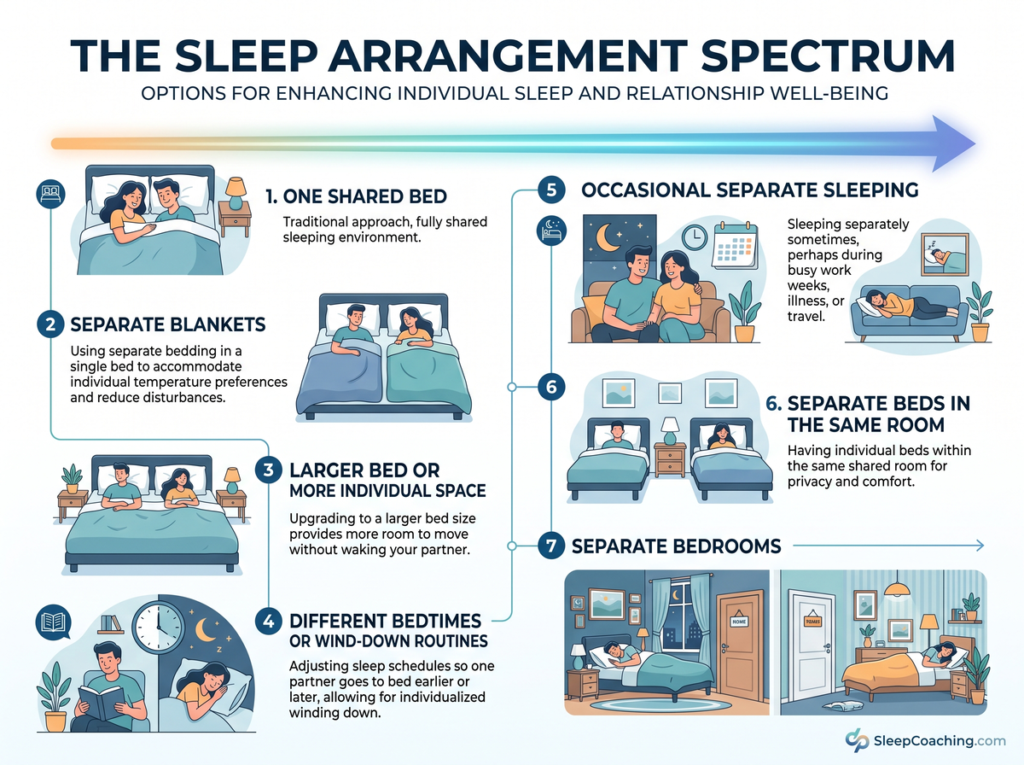
Start by identifying the actual source of disruption.
If the problem is blanket stealing, two duvets may solve it.
If it’s movement, a larger mattress or one with better motion isolation may help.
If it’s temperature, separate bedding or individualized cooling may help.
If it’s different bedtimes, one partner might wind down elsewhere and enter the bedroom quietly later.
If it’s an occasional early alarm, using the guest room on those nights may be enough.
The goal isn’t to preserve bed sharing at all costs.
It’s also not to escalate immediately to separate bedrooms.
It’s to find the smallest change that solves the real problem.
A Sleep Divorce Shouldn’t Be Used to Ignore Snoring
This deserves special attention.
If your partner snores loudly, sleeping in another room may solve your immediate problem.
You can’t hear the snoring anymore.
But moving rooms doesn’t explain why the snoring is happening.
Loud snoring—particularly when accompanied by pauses in breathing, gasping, choking, morning headaches, or excessive daytime sleepiness—can be associated with obstructive sleep apnea.
Obstructive sleep apnea causes repeated interruptions in breathing during sleep and deserves proper evaluation and treatment.
A sleep divorce can remove the sound of snoring from your bedroom. It can’t treat the reason someone is snoring.
If snoring is the primary reason you’re considering separate bedrooms, addressing the snoring itself should be part of the plan.
And because sleep apnea and insomnia can occur together, addressing the underlying sleep problem becomes even more important.
Separate sleeping may protect one partner’s rest.
It shouldn’t become a substitute for addressing a potentially important sleep disorder in the other.
What About Insomnia?
Insomnia creates a different challenge.
Sometimes a partner genuinely contributes to awakenings.
But sometimes the partner becomes part of a larger pattern of sleep-related vigilance.
You start listening for their breathing.
Waiting for them to move.
Wondering when they’ll come to bed.
Checking whether they’re asleep while you’re still awake.
Becoming irritated when they fall asleep easily.
Now the bed isn’t simply a place where your partner occasionally disturbs you.
It’s becoming a place associated with wakefulness, frustration, and monitoring.
Moving to another room may reduce some environmental disruptions, but it doesn’t necessarily treat chronic insomnia.
One of the goals of stimulus control for insomnia is to rebuild a strong association between bed and sleep rather than bed and prolonged wakefulness.
If persistent insomnia is the real problem, changing bedrooms may help in some circumstances—but the underlying insomnia still deserves attention.
The Potential Downsides of Sleeping Separately
A sleep divorce can work extremely well for some couples.
That doesn’t make it consequence-free.
Potential downsides include:
Less Spontaneous Intimacy
Sex and affection sometimes happen because two people are already physically close.
Separate bedrooms may require couples to become more intentional about creating those opportunities.
Loneliness
Some people genuinely sleep better with their partner nearby.
The presence of another person can feel comforting and safe.
If one partner strongly values that closeness, separate sleeping may improve one person’s sleep while worsening the other’s emotional experience.
Different Meanings Assigned to the Arrangement
One person may think:
Finally, we’re both going to sleep better.
The other may think:
My partner doesn’t want to sleep next to me anymore.
If those interpretations aren’t discussed, resentment can grow quietly.
Avoiding the Actual Problem
Sometimes sleeping apart is a practical solution.
Sometimes it’s an avoidance strategy.
Untreated sleep apnea, chronic insomnia, restless legs, relationship conflict, incompatible schedules, alcohol-related snoring, or other issues may still deserve attention even if separate bedrooms make the nights easier.
Becoming Permanent by Accident
A temporary solution can become the default without anyone intentionally choosing it.
There’s nothing inherently wrong with permanent separate bedrooms.
But ideally, both partners should know that they’ve chosen that arrangement rather than simply realizing one day that they haven’t slept together in a year.
How to Try a Sleep Divorce Without Hurting Your Relationship
If you decide to experiment with sleeping separately, treat it like a shared sleep experiment, not a relationship withdrawal.
Agree on the Problem You’re Solving
Be specific.
“Your snoring wakes me four or five times a night” is more useful than “I sleep better without you.”
Make It an Experiment
Try the arrangement for a defined period—perhaps one or two weeks—and then compare how you both feel.
Are you falling asleep more easily?
Waking less?
Feeling more rested?
More patient?
More connected?
Or is one person sleeping better while the other feels worse about the relationship?
Both outcomes matter.
Protect Connection Before Sleep
Separate sleeping doesn’t require separate evenings.
You can still talk, cuddle, read together, have sex, or spend quiet time together before moving to your individual sleep spaces.
Create a Morning Ritual
If waking up together matters to you, recreate that connection intentionally.
Coffee together.
A few minutes talking in bed.
A morning walk.
The ritual matters more than whether you happened to be unconscious on the same mattress for eight hours.
Keep the Arrangement Flexible
Maybe you sleep together on weekends.
Maybe separate rooms are only for work nights.
Maybe you start every night together and separate only when someone’s sleep becomes disrupted.
Maybe separate bedrooms work so well that neither of you wants to change anything.
There isn’t a universal rule.
Check In With Each Other
Don’t evaluate the experiment solely by sleep duration.
Ask:
Are you sleeping better?
And:
How do you feel about us sleeping this way?
You need both answers.
When a Sleep Divorce May Be Worth Trying
Sleeping separately may be especially worth considering when:
- One partner’s snoring or movement repeatedly wakes the other.
- Your schedules are substantially different.
- One partner’s nighttime caregiving responsibilities are disrupting both people unnecessarily.
- Temperature or environmental preferences are genuinely incompatible.
- One partner is temporarily sick, injured, pregnant, recovering, or experiencing another circumstance that makes shared sleep difficult.
- You have already tried simpler environmental solutions without success.
- Both partners are open to experimenting with separate sleep spaces.
- Sleep disruption is creating daytime exhaustion, irritability, or resentment.
The key word is experimenting.
You don’t need to make a permanent relationship decision to find out whether two weeks of better sleep changes how you feel.
When Sleeping Apart May Not Be the Real Solution
A sleep divorce deserves more caution when:
- One partner strongly opposes the arrangement.
- Separate sleeping is being used to punish or withdraw from the other person.
- The primary issue is unresolved relationship conflict rather than sleep.
- Loud snoring, gasping, choking, or breathing pauses suggest possible sleep apnea.
- Chronic insomnia continues regardless of where you sleep.
- One partner feels increasingly lonely or disconnected.
- Separate rooms improve sleep but significantly reduce intimacy and neither partner is addressing it.
Sometimes the answer is separate bedrooms.
Sometimes it’s a sleep study.
Sometimes it’s insomnia treatment.
Sometimes it’s a bigger bed.
Sometimes it’s couples counseling.
And sometimes it’s simply two blankets.
Solve the problem you actually have.
Is a Sleep Divorce Right for You?
There isn’t a universal answer. If you’re wondering whether sleeping separately might help, this 2-minute quiz can help you think through your sleep situation and identify the next step that may make the most sense for you and your partner.
Is a Sleep Divorce Right for You?
Answer 8 quick questions about your sleep situation and get personalized guidance based on your answers.
Frequently Asked Questions
What does sleep divorce mean?
A sleep divorce means romantic partners intentionally sleep in separate beds or rooms, usually because sharing a sleep space is interfering with one or both partners’ rest. Despite the name, it does not mean the couple is separating or experiencing relationship failure.
Is sleep divorce healthy?
It can be. Sleeping separately may be helpful when a partner’s snoring, movement, schedule, temperature preferences, or other habits repeatedly disrupt sleep. The arrangement is most likely to work well when both partners agree with it and continue prioritizing emotional and physical connection.
Can sleeping in separate beds improve a relationship?
For some couples, yes. Better sleep may reduce exhaustion, irritability, and resentment caused by repeated nighttime disturbances. However, other couples may miss the closeness and spontaneous intimacy of sharing a bed. The effect depends heavily on the couple and how the arrangement is handled.
Is it normal for married couples to sleep separately?
Separate sleeping arrangements are more common than many people assume. Couples may sleep separately permanently, occasionally, or during specific circumstances such as illness, different work schedules, parenting demands, snoring, or periods of poor sleep.
Does sleeping separately mean a relationship is in trouble?
No. Some happy couples intentionally sleep separately because they rest better that way. What matters more is whether the arrangement is mutually agreed upon and whether both partners continue to feel connected and satisfied with the relationship.
Should couples sleep separately because of snoring?
Separate sleeping may protect the non-snoring partner’s sleep, but loud or disruptive snoring shouldn’t simply be ignored. Snoring accompanied by breathing pauses, gasping, choking, or excessive daytime sleepiness can be associated with obstructive sleep apnea and should be evaluated.
Can a sleep divorce help insomnia?
It may reduce disturbances caused by a partner, but separate sleeping does not necessarily treat chronic insomnia. If insomnia persists regardless of sleeping arrangement, evidence-based insomnia treatment may be more appropriate.
Do you need separate bedrooms for a sleep divorce?
No. Couples can use separate beds in the same room, sleep separately only on certain nights, use different bedding, or start the night together and move to different sleep spaces later. The arrangement can be as flexible as the couple wants.
Better Sleep Doesn’t Require Following Someone Else’s Rules
For generations, sharing a bed has been treated as part of the definition of a close relationship.
But sleep doesn’t care much about symbolism.
Your nervous system responds to sound, movement, temperature, light, timing, comfort, safety, and countless other signals throughout the night.
Sometimes the person you love happens to interfere with several of them.
That doesn’t mean the relationship is failing.
And sleeping separately doesn’t automatically mean the relationship will improve.
A successful sleep divorce isn’t really about distance.
It’s about intentionally creating conditions where both people can rest without losing the connection that made them want to share their lives in the first place.
Start with the problem.
Try the smallest change that might solve it.
Talk openly about how the arrangement feels.
And remember that no relationship earns extra points for sacrificing sleep simply because couples are “supposed” to share a bed.
The goal isn’t to sleep together or apart. The goal is to wake up rested—and still feel close.

Stone Evans, Founder of SleepCoaching.com
Stone Evans is the founder of SleepCoaching.com which has become one of the most popular destinations online for people seeking better sleep. Stone started developing this website after realizing his own sleep struggles and then beginning an intensive period of study (which included professional sleep coach training) and ongoing lifestyle changes to improve and optimize his sleep.
Now through in-depth articles from sleep experts around the world, the internet's leading and most comprehensive sleep coaching directory, quantitative sleep product reviews and Stone's personal daily sleep tracking journey, visitors to our website regularly report gaining information and insights that are helping them achieve better health, better sleep and a better quality of life.

